Get Full Government Meeting Transcripts, Videos, & Alerts Forever!
Get email alerts on the Landmarks Development topic
No spam. Unsubscribe anytime.
Neighbors and unions split as Community Board 2 reviews 19‑story plan for 375 Lafayette Street
Summary
Community Board 2’s Landmarks Committee heard a detailed presentation on a proposed 19‑story residential building at 375 Lafayette Street that would deliver roughly 200–210 units (about 50–53 permanently affordable at 60% AMI) but drew sharp criticism over bulk and façade treatment from preservation groups and nearby residents while unions and housing advocates urged approval for homes and jobs.
A developer presentation and extended public comment period on a proposed 19‑story residential building at 375 Lafayette Street left Community Board 2 Manhattan’s Landmarks Committee with a split record and a long list of technical follow-ups.
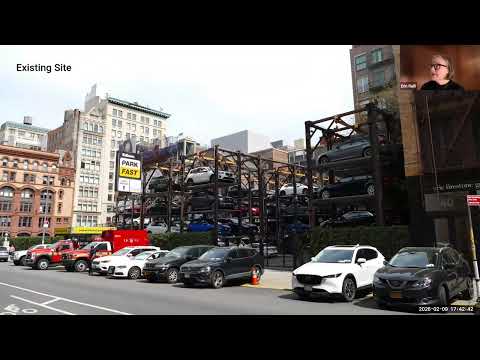
Joseph Mang, head of development at Minskoff, told the committee the project replaces a long‑standing surface parking lot with a new residential building designed with Skidmore, Owings & Merrill and other consultants. The development team said it expects roughly 200–210 units in the scheme, with 25% of units — about 50–53 — set as permanently affordable at 60% of area median income (AMI). The team also proposed 5,500–7,000 square feet of ground‑floor retail, approximately 25–30 subsurface parking spaces, and a maximum architectural top height of 195 feet under the applicable zoning envelope.
“The site has been underutilized for decades,” Mang said, asking the committee for support and noting the project’s transit access and housing yield.
Gary Ku, the project architect, described a massing strategy that steps down from a taller corner to a lower centre‑of‑block expression and emphasized a masonry‑forward palette centered on terracotta and a strong stone base at street level. Ku said the building is designed to reference the district’s historic rhythms — including a repeated 25‑foot bay module and decorative cornice ideas — while meeting contemporary energy‑performance standards.
But the presentation prompted sustained criticism from preservationists and nearby residents. Andrew Berman, executive director of Village Preservation, told the committee, “This building is way too big,” arguing the massing and long, repetitive façade would overwhelm Great Jones Street and that the rear (north) face appeared “monolithic and oppressive.” Berman also noted the project team alternately referred to 290,000 and 210,000 square feet in the presentation and asked for clearer explanation of those figures.
Multiple residents who live on or near Great Jones Street echoed Berman’s concerns, saying the proposed slab‑like mass would dwarf existing three‑to‑seven‑story façades on the street, eliminate important light and views for neighbors, and alter the block’s historic character. Speakers urged breaking up the mass into distinct volumes, adding deeper setbacks or more detailed cornices, and improving the visible north elevation.
Other community voices urged a different calculus. Several construction‑industry and labor representatives supported the project for its housing and jobs, and trade union speakers said they expected union wage standards to apply on the site. Testimony in favor also described the parking lot as an underused site and said delivering new housing near transit serves citywide affordability and sustainability goals.
Committee members spent the business session balancing those points. A majority expressed concern about the Great Jones Street façade, calling it “too flat,” “too vertical” and insufficiently articulated. Several members said the Lafayette Street elevation was closer to acceptable, but that the project overall reads as a single massive box rather than a composition that fits the NoHo Historic District Extension.
Members requested a number of specific items before drafting a formal letter or resolution: a detailed unit‑mix and floor‑area breakdown (including how the 25% affordable requirement is distributed by floor area), a clear explanation for why the proposal is being delivered as two legal buildings rather than a single building (and why the two lobbies/entrances are treated differently in the drawings), more refined façade studies showing how the Great Jones Street elevation would transition to adjacent low‑rise buildings, bike‑parking counts, and additional detail on the loading/garage approach. The committee also noted the site’s former use as a filling station and asked the applicant to address excavation and neighboring‑building protection in further materials.
The applicant said the scheme is being designed as two building cores under the 45X program in order to maximize housing on the constrained lot while meeting programmatic and code requirements; the development team committed to the $40/hour construction wage threshold the team described as required for this size and type of work. The applicant also said signage and storefront treatments would remain limited to the storefront infill and that operable street‑wall windows would be restricted to shallow openings for cleaning with limiters.
Next steps: Community Board 2 will draft a recommendation for the full board based on changes the committee requests. The Landmarks Preservation Commission review is scheduled by the applicant for March 10, when the design team will present a refined scheme; committee members asked the applicant to provide unit‑mix tables, clearer lobby/entrance rationale and revised façade diagrams in writing ahead of that appearance.
What’s at stake: The proposal would create more than 200 apartments in a transit‑rich part of Manhattan, including a set‑aside of permanently affordable rental homes, but committee members signalled they are not prepared to endorse the proposal without visible changes to break up massing and improve the pedestrian scale of Great Jones Street. The board’s forthcoming letter will register both the community’s demand for housing and its preservation‑driven concerns about scale, materials and transitions.