
House Finance committee advances a package of tax bills, including grocery-store incentives and tobacco tax changes
Get AI-powered insights, summaries, and transcripts
Sign Up Free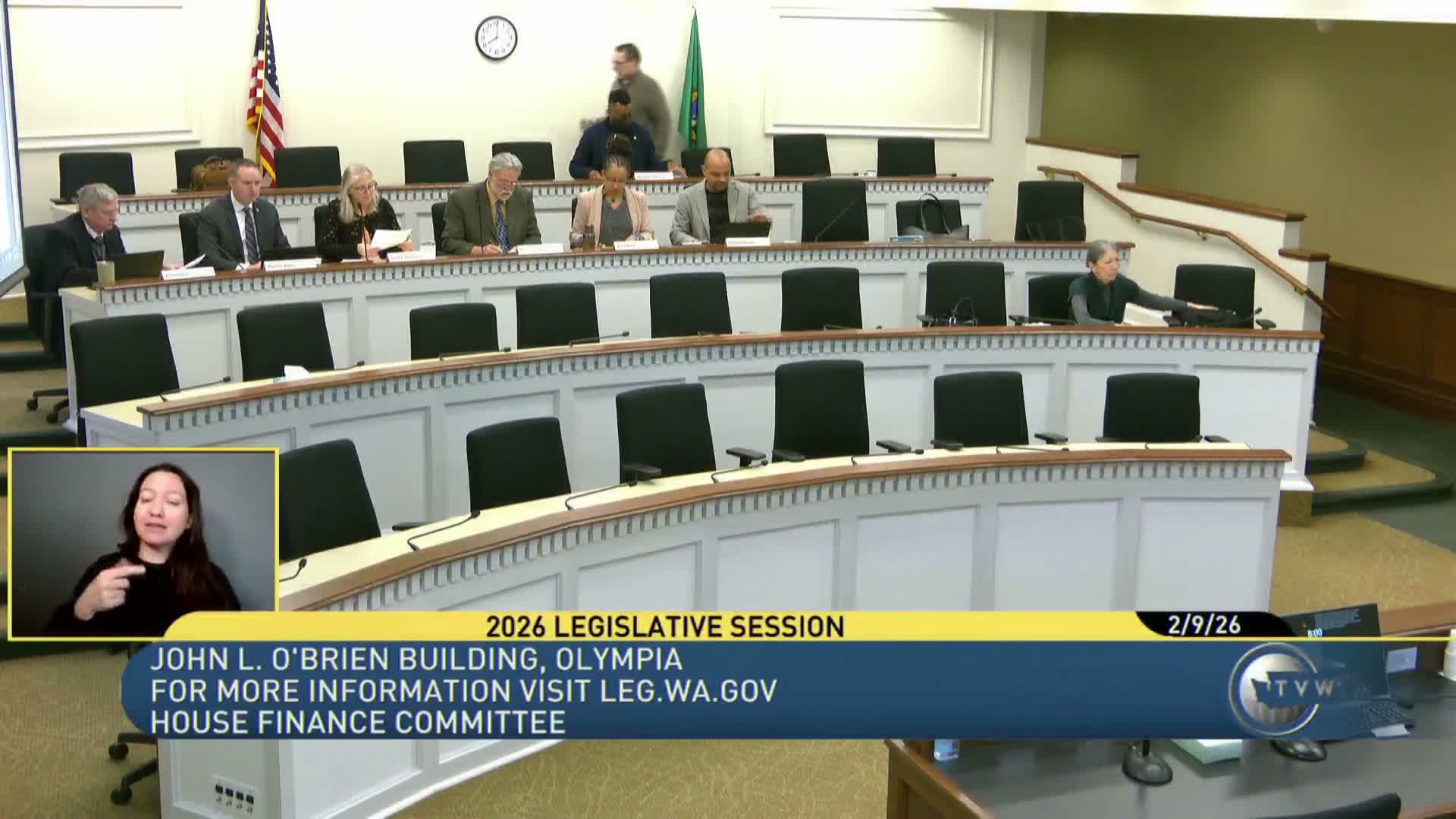
Summary
The Washington House Finance Committee on Feb. 9 held an executive session to brief and vote on a large package of tax bills. Substitutes for multiple bills — including HB 22-97 (grocery incentives), HB 23-82 (cigarette and vapor taxes) and several others — were reported out of committee with due-pass recommendations after amendment votes and debate.
The Washington House Finance Committee met in executive session on Monday, Feb. 9, to consider a tranche of tax and revenue bills and reported a series of substitute measures out of committee with due-pass recommendations.
The most contested measure was substitute House Bill 22-97, which would create tax incentives aimed at bringing grocery stores to designated underserved community zones. Christina King, staff to the committee, summarized the proposed substitute (HDash3481.1) and an Orcutt amendment that would remove a state and local property tax exemption program. Representative Orcutt cautioned that “Whenever you exempt somebody from paying property tax, it doesn't take the actual tax off of being paid,” warning the exemption shifts costs to other taxpayers. Representative Mena responded that “The property tax incentive is a really big part of incentivizing grocery stores to come in these underserved communities zones,” saying the measure targets a small number of eligible zones and is intended to improve local access to food and pharmacies. After debate the committee recorded 9 ayes, 5 nays and 1 excused and reported the substitute out of committee with a due-pass recommendation.
The committee also moved substitute House Bill 23-82, a comprehensive change to tobacco-related taxes that would raise the cigarette tax by $2 per pack, restructure the vapor-products tax to 95% of retail price and change other product caps and revenue flows. Representative Penner urged an amendment to direct more of the additional cigarette-tax revenue into the state's Health Care Affordability Account, arguing the revenue should be transparently linked to health outcomes. The committee adopted some technical and targeted amendments (including language directing first deposits to the Andy Hill Cancer Research Endowment Fund where specified) and rejected others; substitute HB 23-82 was reported out 8–6 (1 excused).
Other bills advanced in the session included:
- House Bill 24-87 (HB 2487): clarifies the insurance premium exception to the B&O tax and revises definitions and retroactivity provisions; reported out 8 ayes, 6 nays, 1 excused.
- Substitute House Bill 2,089: narrows a B&O tax preference for certain financial institutions and directs resulting revenue to wildfire-mitigation priorities; reported out 9 ayes, 5 nays, 1 excused.
- House Bill 24-31: increases the maximum fundraising threshold for nonprofit public-assembly properties; passed by voice vote (14–0, 1 excused) and reported out with a due-pass recommendation.
- Second substitute House Bill 24-51: several technical and policy clarifications to tax increment financing, including CPI references and public-improvement definitions; reported out 13–1–1 (aye–nay–excused).
- Second substitute House Bill 2,590: narrows who may purchase ownership interests in limited-equity cooperatives and clarifies income restrictions in governing documents; vote result 10–4–1, reported out with a due-pass recommendation.
- Second substitute House Bill 23-25: establishes a tourism self-supported assessment program with an opt-in provision for federally recognized tribes; reported out 8–6–1.
- House Bill 22-78: removes the sunset on a $3 per-room per-night charge to support tourism promotion; reported out 10–4–1.
- Substitute House Bill 2,224: reported out 11–3–1 after debate over local funding shifts and implications for junior taxing districts.
- Substitute House Bill 23-22: a technical change removing a volumetric trigger for sustainable aviation fuel tax benefits and replacing it with a date-certain standard; reported out by voice vote (14–0–1).
Committee members repeatedly emphasized process limits and inter-committee coordination: several speakers urged further work on retroactivity issues and alignment with policy committees that had considered substantive subject matter (for example, vapor-product policy and tobacco regulation). Where amendments were adopted, staff indicated intent to continue work as bills move to the floor.
Votes at a glance (selected items): - Substitute HB 22-97 (grocery-store incentives): 9 ayes, 5 nays, 1 excused — reported out with a due-pass recommendation. - HB 24-87 (insurer B&O tax provisions): 8 ayes, 6 nays, 1 excused — reported out with a due-pass recommendation. - Substitute HB 23-82 (cigarette/vapor taxes): 8 ayes, 6 nays, 1 excused — reported out with a due-pass recommendation. - Substitute HB 2,089 (financial institutions): 9 ayes, 5 nays, 1 excused — reported out with a due-pass recommendation. - HB 24-31 (nonprofit assembly halls): voice vote, 14 ayes, 0 nays, 1 excused — reported out. - Second substitute HB 24-51 (tax-increment finance): 13 ayes, 1 nay, 1 excused — reported out. - Second substitute HB 2,590 (limited-equity co-ops): 10 ayes, 4 nays, 1 excused — reported out. - Second substitute HB 23-25 (tourism self-assessment): 8 ayes, 6 nays, 1 excused — reported out. - HB 22-78 (lodging charge continuation): 10 ayes, 4 nays, 1 excused — reported out. - Substitute HB 2,224: 11 ayes, 3 nays, 1 excused — reported out. - Substitute HB 23-22 (sustainable aviation fuel timing): voice vote, 14 ayes, 0 nays, 1 excused — reported out.
What to watch next: most bills were reported out of the House Finance Committee with due-pass recommendations and will be scheduled for floor consideration in the House. Several bills include provisions flagged for further work (retroactivity language, coordination with policy committees on tobacco and vapor products, and technical definitions for underserved community-zone designations).
Ending: The committee adjourned after reporting the substitute measures; staff noted two listed public-hearing bills were not reached and may be rescheduled.