
Senate committee advances statewide ban on student phone use during the school day with grant funding
Get AI-powered insights, summaries, and transcripts
Subscribe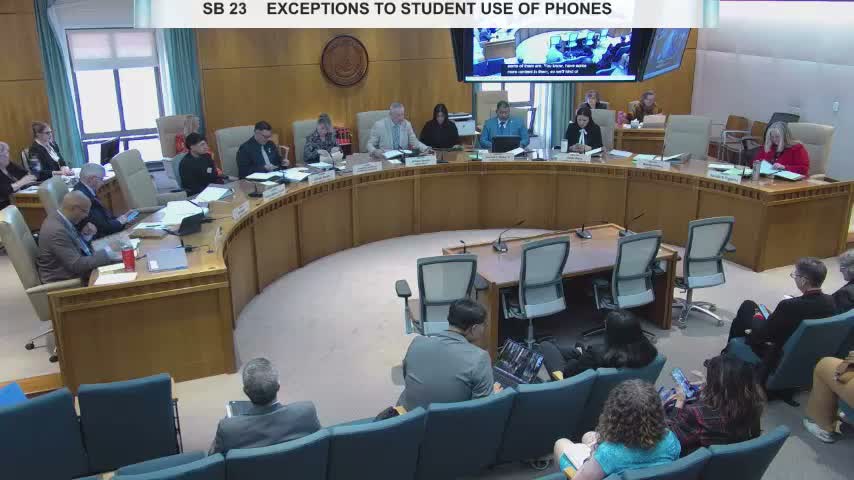
Summary
The Senate Education Committee voted to ‘do pass’ SB 23, which would require districts and charters to adopt policies banning student use of wireless devices during the school day (with medical, assistive‑technology, and instructional exceptions) and make districts eligible for funding to implement the policies.
Senate Education committee members voted to advance Senate Bill 23, a measure that would require every school district and charter school in New Mexico to adopt a policy prohibiting student use of wireless communications devices during the school day while preserving exceptions for medical needs, assistive technology and educator‑approved instructional use.
Sponsor testimony framed the bill as a follow‑up to last year’s SB 11 and as part of a nationwide effort. Jeff Lopez of the New Mexico Office of Broadband told the committee, “This bill proposes to use $1,000,000 of existing authority for this purpose to support school districts, schools, and charter schools with implementing this policy.” PED Deputy Secretary Yvonne Garcia emphasized the exceptions and the phased timetable, saying the bill “is implemented by grade level” and will begin in middle schools first to reduce distractions and support teacher instruction.
Multiple educator and labor groups offered support. Melanie Carmona of the NEA New Mexico said enforcing clear cell phone policies improves engagement and classroom culture; John Dirich of AFT New Mexico praised a phase‑in approach. Groups representing teachers, school districts and child advocacy organizations told the committee consistent expectations across schools help both instruction and family understanding.
Committee members pressed sponsors on administration and enforcement: who enforces policies, whether charters and virtual programs are covered, and whether the ban applies during recess, lunch and school‑day activities. Sponsors and PED staff said the bill replaces the phrase “instructional hours” with “school day,” making the restriction apply across school hours, and that districts and charters will create and enforce the required policies. PED advised that virtual programs would need policies adapted to their learning environments and that the department cannot monitor activity within students’ homes.
Several senators raised concerns about local control and teacher burden. One member argued that school boards should make such decisions locally; supporters countered that a statewide policy relieves teachers of being the sole enforcers and couples the mandate with funding and tools (for example, device storage pouches) to reduce day‑to‑day enforcement burdens.
The committee recorded a do‑pass motion and advanced SB 23 on a 6–3 vote. Next steps: the bill will move to the next committee of referral as the legislative process continues.
Ending: The committee advanced SB 23 after extended testimony and questioning and recorded a do‑pass recommendation; sponsors and education officials said they would supply additional district implementation data requested by the committee.