Get Full Government Meeting Transcripts, Videos, & Alerts Forever!
Get email alerts on the Ems Services topic
No spam. Unsubscribe anytime.
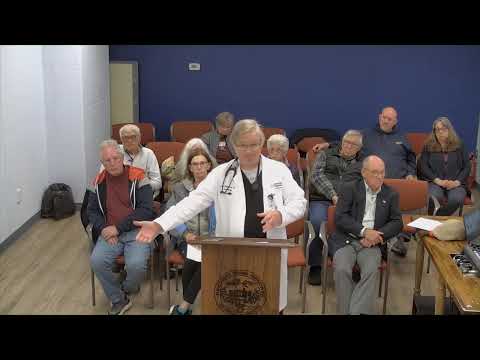
Dr. Patterson outlines EMS gains and gaps in Floyd County, calls for mental‑health support for crews
Summary
Dr. Patterson, the EMS medical director and cardiology director at LewisGale Montgomery, told Floyd County leaders about training upgrades, a state mandate to set up an in‑house EMS pharmacy, use of the Pulsara field‑to‑hospital system, persistent staffing shortages and the need for formal psychiatric support for first responders.
Dr. Patterson, the medical director (OMD) for the county's EMS services and director of cardiology at LewisGale Montgomery, briefed Floyd County leaders on efforts to tighten prehospital care and the persistent operational challenges facing rural EMS.
He said improving rural outcomes requires bringing medical capability into the field. "When I took over Floyd services, I had some goals in mind. I wanted to really focus on the quality of care," Dr. Patterson said, describing stepped‑up training in airway management and other low‑frequency, high‑complexity procedures. He said those cases are reviewed routinely: "If you've intubated, we're reviewing it. Right? Because we need to make sure every time it goes well."
Patterson reported service volume and logistical constraints that frame the county's work: "Keep in mind, y'all have done 822 transports since January," he told the meeting, and he noted that parts of the county can be a 50‑minute drive to the nearest hospital in good weather — longer in fog or rain. That geography, he said, makes rapid field assessment and efficient routing essential.
He described a recent state requirement that EMS entities establish an in‑house pharmacy and credited local staff for meeting the mandate. "They had it all knocked out. It met state requirements," Patterson said of the local team's implementation.
To improve communication between crews and hospitals, Patterson described adoption of the Pulsara platform, which he said supports two‑way communication of EKGs and alerts with minimal bandwidth: "It allows field [alerts]… As soon as it can ping out, it will alert everybody." He said LewisGale and Salem participate in the system but that Carilion hospitals had not signed on, sometimes prompting slower, phone‑based activations.
Pulsara, he said, enabled faster lab activation for heart attacks and strokes and gives specialists a way to cancel false activations: "...there's a big red stop button. So if for some reason I feel strongly it's not a heart attack, I can push the stop button, call off the dogs." Patterson described best case door‑to‑balloon times of about 12 minutes when the hospital is prepped, versus a typical 30‑minute turnaround when crews arrive without prior notice.
Workforce shortages remain a major constraint. "There's a national shortage. We cannot get EMS anywhere, not just here," Patterson said, noting falling volunteerism and difficulty hiring paid staff. He said the county must plan strategically by geography and increase vehicle and personnel capacity over time to expand coverage.
A substantial portion of the discussion focused on mental‑health support for responders after traumatic calls. Patterson described limited formal psychiatric support for EMS crews and urged local coordination: "There is not a good formal psychiatric support network for these people," he said. He agreed to contact Chris Taylor at Community Services to explore a counselor‑at‑the‑hospital pilot and suggested that a successful local program could be presented to the state as a model.
Attendees credited Patterson and local staff for rapid implementation of the pharmacy and training programs and thanked him for ongoing availability to review cases and advise crews by phone and text. The briefing ended with expressions of appreciation and a commitment to pursue the proposed mental‑health coordination.
Next steps described at the meeting included outreach to Community Services (Chris Taylor) to explore on‑site counseling for first responders and continued promotion of Pulsara to partner hospitals; no formal motions or votes were recorded during the exchange.