
Rules attorney flags constitutional doubt on HB 2331’s utility mandate
Get AI-powered insights, summaries, and transcripts
Sign Up Free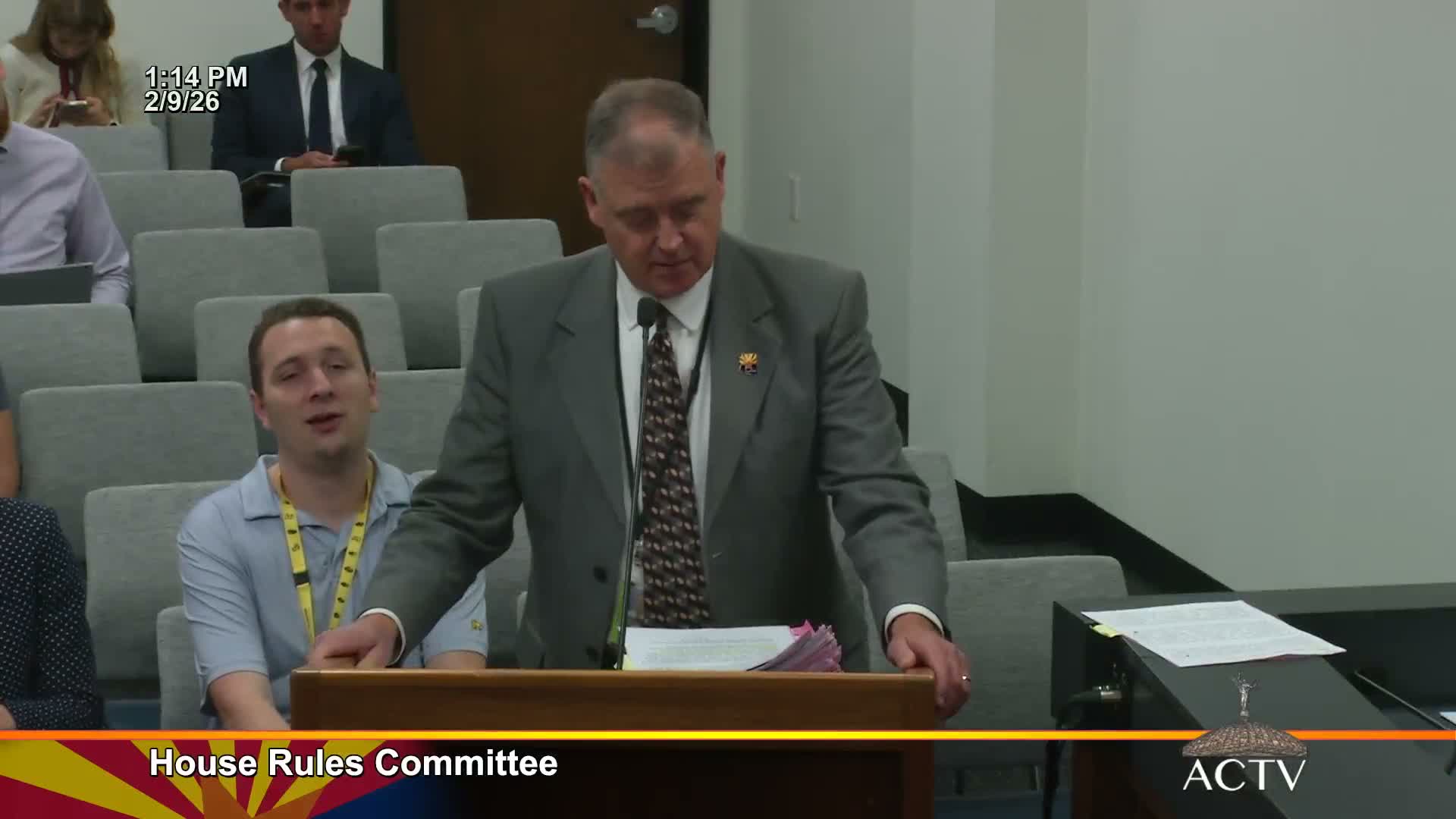
Summary
House Bill 2331 would require 85% of electricity sold by public service corporations to come from “reliable” sources (excluding wind and solar) by 2030. The rules attorney told the committee it may intrude on the Arizona Corporation Commission’s exclusive rate- and resource-integration authority, making the bill constitutionally doubtful, though the committee recommended it as proper form.
The Arizona House Rules Committee voted to recommend House Bill 2331 as constitutional and in proper form, while the rules attorney warned the measure raises questions about the state constitution’s allocation of authority over utilities.
Tim Fleming, the rules attorney, summarized an amendment adopted by the Natural Resources Committee and said HB 2331 would require that by 2030 "85% of electricity generated by the power companies" come from "reliable sources, which means not wind and not solar sources" (SEG 155–159). Fleming said enforcement would fall to the Arizona Corporation Commission, which already regulates public-service utilities.
Fleming cautioned that the state constitution (Article 15, Section 3) grants the Corporation Commission exclusive authority over rate-making, and that courts have emphasized many variables relevant to utility rate decisions. He said "reasonable minds can differ" but concluded the bill is "constitutionally doubtful" if challenged, even though it is in proper form for committee action (SEG 162–185).
Members discussed relevant case law, including Johnson Utilities and another earlier case (SEG 188–201). Representative Carter said some commissioners in his district told him they view the legislature as setting policy while the commission sets rates, and he voted Aye (SEG 242–262). The committee recorded a 5-2-1 vote to recommend the bill as constitutional and in proper form.
What’s next. Fleming recommended clarifying statutory language or leaving agency discretion intact to reduce constitutional risk; any challenge would be resolved in the courts if the bill became law.