
Council committee reviews $100,000 contract to Spokane Immigrant Rights Coalition amid questions on process and oversight
Get AI-powered insights, summaries, and transcripts
Subscribe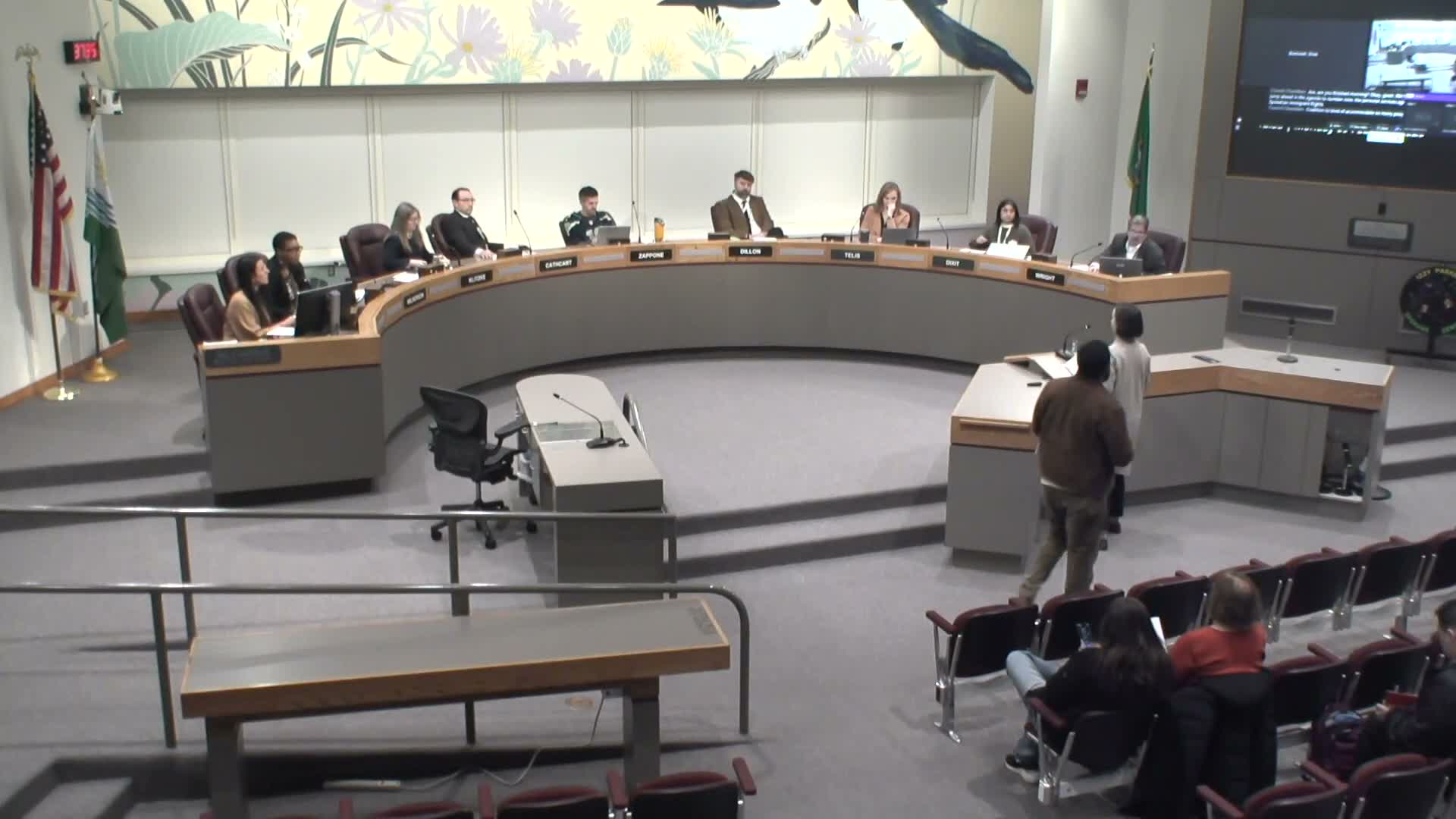
Summary
The committee heard public testimony both supporting and opposing a proposed $100,000 personal services contract with the Spokane Immigrant Rights Coalition (CERC). City staff and CERC representatives said 92% of funds would go directly to households; council members pressed for procurement, reporting and anti‑lobbying safeguards.
The Public Infrastructure and Environmental Sustainability Committee on Feb. 10 reviewed a proposed $100,000 personal services agreement to create a Community Justice Fund administered by the Spokane Immigrant Rights Coalition, a coalition fiscally sponsored by Muslims for Community Action and Support (MCAS).
City staff and CERC representatives told the committee the fund is intended for urgent, short‑term needs — transportation to hearings, temporary lodging, childcare, medical exams and communication for families with relatives detained by immigration authorities. Sebastian, speaking for CERC, said about 92% of money deposited into the coalition’s account reaches households after an approximately 8% fee to MCAS for fiscal‑sponsorship services.
The proposal drew mixed reaction during a long public‑comment period. Supporters in the room said the funds would provide rapid stabilization for immigrant families and urged quick disbursement. Opponents, including Jennifer Mesa (executive director of Latinos in Spokane) and a resident identified as Mauricio, said the city did not consult all immigrant‑serving groups and urged an open RFP process so registered nonprofit organizations could compete.
Council member Rick Cathcart pressed staff on procurement and budget sourcing: he asked whether the contract followed an RFP process and where city money for the contract was identified. City staff said an informal procurement consistent with internal rules for contracts under $250,000 was used and that Seattle Police Department (SPD) budget lines identified funding for community outreach in 2026. Staff said the item was included in SPD’s modified/biennial budget planning rather than in earlier citywide budget deliberations.
Cathcart and others also asked how the city would ensure public dollars are not used for lobbying or legal representation. Staff pointed to contract language that excludes lobbying and legal representation and requires quarterly reporting and specific data returns to the city as conditions for continued funding.
Mesa told the committee she has concerns about governance and fiscal accountability because CERC itself does not hold 501(c)(3) status; city staff and CERC responded that MCAS serves as a 501(c)(3) fiscal sponsor and handles banking, taxation and disbursement. Cathcart noted the CERC website’s volunteer/donation links currently use a form powered by Fuse Washington (a state political organization), and said that raised additional questions about whether funds or operations could be used for political activity. City staff said the contract’s permissible uses are limited to emergency financial needs and excludes lobbying/legal representation.
No formal vote on the contract was recorded during the committee meeting. Staff said the contract requires quarterly reporting and other compliance measures and that the administration worked with procurement and legal to draft the agreement.
The committee moved on to other business to preserve time; committee members asked staff to provide additional written detail on the procurement process, exact reporting metrics and the contract line items that indicate the $100,000 is coming from SPD’s community outreach/investments budget.