Get Full Government Meeting Transcripts, Videos, & Alerts Forever!
Get email alerts on the Housing Development topic
No spam. Unsubscribe anytime.
Bloomington reviews Hopewell South PUD aiming for about 100 homes, most below AMI thresholds
Summary
City officials and consultants presented a Planned Unit Development for Hopewell South that would add roughly 84–98 homes and, according to the consultant’s analysis, about 70 of 98 units (≈71%) would meet federal affordability definitions tied to AMI; council members pressed on price points, ownership models, building‑code barriers and whether a PUD or a zoning change is the right tool.
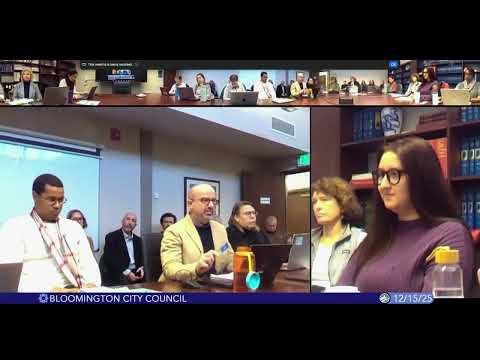
Bloomington City held a special session on Dec. 15 to review a proposed Planned Unit Development for Hopewell South, the 24‑acre former hospital campus south of 1st Street. Mayor Thompson and city planning staff framed the PUD as a pilot to speed production of smaller, more attainable homes while preserving select buildings on the site.
Consultant Allison Quinlan of Flintlock Labs, who led the design presentation, said the plan would yield roughly 84 homes under one scenario and nearly 98 units in the team’s final version, with a mix of small homes, micro units and a few larger corner family houses. “Our current price point here is $270,000,” Quinlan said during the council Q&A, and she identified a range that runs from the smallest studio at about $83,000 to corner family homes around $650,000.
The team tied affordability to area median income (AMI) bands and said the development would include layered affordability tools. Quinlan told council members that, per the project spreadsheet, “70 of our units out of 98 … 71% of units that are proposed within Hopewell South are gonna be affordable under federal definitions.” She also said the project contemplates forgivable down‑payment assistance for qualified buyers but that the calculations presented do not assume the city is giving land away.
David Hittle, the city’s director of planning and transportation, described the procedural path: the proposal has gone through the Development Review Committee and could appear before the Plan Commission on Jan. 12 before returning to the City Council. He also explained that a PUD is effectively custom zoning for the property and that any final development ordinance would specify dimensions, frontage and other standards.
Council members focused questions on price‑point detail, the ownership model for small and attached units, operational logistics and the project’s legal and financing constraints. Quinlan said the design team favors very small single‑family lots and preapproved plan catalogs so individual units can be sold fee simple and financed with traditional mortgages. She cautioned that small multiplexes are often impractical under current codes and finance structures: “When something hits the international building code, 3 units or more, it’s the same code we used to do airports and factories,” and that code jump can make construction costs substantially higher and mortgage financing harder to obtain for buyers.
Several council members asked if the team had analyzed alternatives to a PUD, such as expanding the Transform Redevelopment Overlay (TRO). Quinlan and Hittle said staff reviewed that option but found the TRO could not accommodate custom street sections and the very small lot dimensions the team is proposing; those technical limits were a primary reason the consultant recommended a PUD pilot. Hittle added that the city’s Unified Development Ordinance encourages absorption of PUDs into conventional zone districts over time and that a future conversion to a standard district is possible.
Other practical topics raised during the session included trash staging on small lots (Quinlan said bin dimensions and permeable pad staging have been designed), the conceptual status of the police‑station block (Block 8), and whether single‑room‑occupancy units have been considered (Quinlan said SROs have not been recommended for Hopewell South but noted they can be a deep‑affordability tool and her firm is piloting SRO work elsewhere).
The presentation was largely an information and feedback session rather than a request for a vote. The city and consultant team said they will share detailed spreadsheets and design packages with council and the RDC, and that the formal Plan Commission and council reviews remain the next steps.
The Plan Commission schedule and any formal petitions or ordinances associated with the PUD will determine timing for a final council decision.