
Bloomington staff recommend keeping Kirkwood open in 2026, shift to parklets and corridor study
Get AI-powered insights, summaries, and transcripts
Subscribe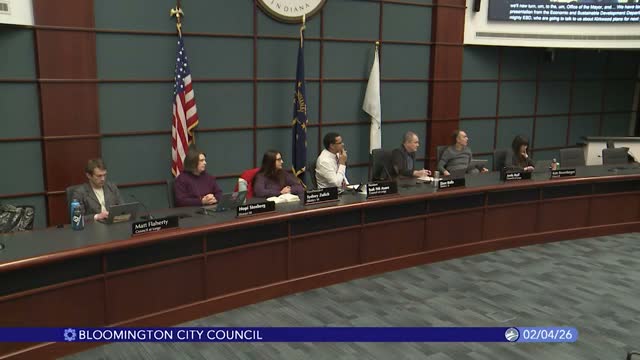
Summary
City staff told the Common Council they will keep Kirkwood Avenue open to vehicles in 2026, expand and upgrade parklets and pursue micro-activations while seeking funding for a 2027 corridor study; public commenters and some council members pushed back and asked for more details before the city engineer invokes section 7 to suspend closures.
City staff recommended Feb. 4 that Bloomington keep Kirkwood Avenue open to vehicles for 2026 while redirecting resources toward improved parklets, targeted ‘micro-activation’ events and long-range planning.
Jane Cooper Smith, director of the Economic and Sustainable Development department, told the Bloomington Common Council that the city intends to activate section 7 of ordinance 25 0 2 if necessary, which gives the city engineer authority to temporarily or permanently suspend parts of the outdoor dining closure program. She said the engineer would submit a statement to council and the Board of Public Works and that such a suspension could occur with 14 days’ notice to affected businesses and a 45-day report to council describing the reasons.
Special projects manager Chaz Modinger presented the staff recommendation and supporting data. Modinger said staff observed a 57% increase in event activity and 16 more program days in 2025 but nevertheless measured an 8% decline in average daily visits, concluding that full street closures alone were not producing consistent corridor vibrancy. Modinger described five recurring challenges with the 2025 model: uneven economic impacts for different businesses, lack of permanent infrastructure (shade, seating, hardscaping), limited staff capacity to program closed streets, public-safety concerns associated with temporarily closed but unactivated spaces, and accessibility and delivery challenges. Staff also cited an estimated $80,000 annual parking revenue loss tied to closures and reported only about $17,500 in program fee revenue to offset closure costs.
On that basis staff recommended keeping Kirkwood open to vehicles in 2026, expanding the parklet program with accessible, sidewalk-level platforms, adding greenery and lighting, finding longer-term barriers to replace orange jersey barriers, and funding a Kirkwood corridor study as part of the 2027 budget cycle (with a request-for-proposals process beginning in late 2026).
The staff presentation prompted questions from council members about operational details and legal authority. Council member Zulek asked whether closures might be used for Indiana University home football games; staff replied that the administration had not planned blanket closures for every game and that occasional targeted closures could be possible. Council members also pressed staff about which of the section 7 reasons — emergency, lack of participation, or impracticality — the engineer would rely on; staff said the draft memo points most clearly to the program being rendered “impractical” by multifactorial operational constraints.
Public comment during the special Kirkwood session was strongly mixed. Dozens of residents and business owners spoke over multiple public-comment rounds. Some — including longtime business owners and the Kirkwood Community Association president, Bob Cassello — called the street-closure program a valuable pedestrian space and said they felt blindsided by a staff memo recommending suspension. Cassello told the council that businesses had relied on the ordinance’s multi-year stability when they invested in the corridor and criticized the timing and outreach for the staff memo. Other commenters, including delivery drivers and pedestrians, urged the city to consider targeted closures and improved activation rather than a full-year closure policy.
Downtown Bloomington Inc. and the Greater Bloomington Chamber of Commerce acknowledged the value of outdoor dining while urging improvements in consistent activation, shade and funding; chamber representative Chris Ramsey suggested using proceeds from other city property sales to seed permanent Kirkwood infrastructure.
Council members expressed divided views. Some said they appreciated staff’s candor about operational limits and supported a corridor study and improved parklets; others said invoking section 7 without more engineering input would subvert the intent of the ordinance the council passed last year and erode business confidence.
Staff emphasized next steps: if the city engineer issues a notice under section 7 the memo will be provided to council and businesses per the notice timelines; ESD will pursue funding for a corridor study in the 2027 budget cycle and issue a request for proposals in late 2026; staff also said they will return with additional details and engage stakeholders in follow-up meetings.
No formal ordinance or council vote to change the Kirkwood program was taken during the Feb. 4 meeting; council members agreed to continue deliberations and to hold further conversations and possible deliberation sessions to consider policy responses.
Ending: The council extended public-comment time during this item and asked staff to continue engagement; staff signaled the engineer’s notice could come as soon as the next day, and the council noted it would expect formal notice and a follow-up report if the engineer activates section 7.