Get Full Government Meeting Transcripts, Videos, & Alerts Forever!
Get email alerts on the Wildland Urban Interface topic
No spam. Unsubscribe anytime.
Holladay planning commission forwards wildland-urban-interface boundary to city council amid questions on fees, trees and insurance
Summary
The Holladay City Planning Commission voted Oct. 28 to recommend the city council adopt a Wildland Urban Interface (WUI) overlay and associated 2006 building-code provisions to meet state House Bill 48; staff and Unified Fire Authority outlined that the overlay targets new construction and defensible-space rules, while state rules on fees and parcel-level assessments remain unresolved.
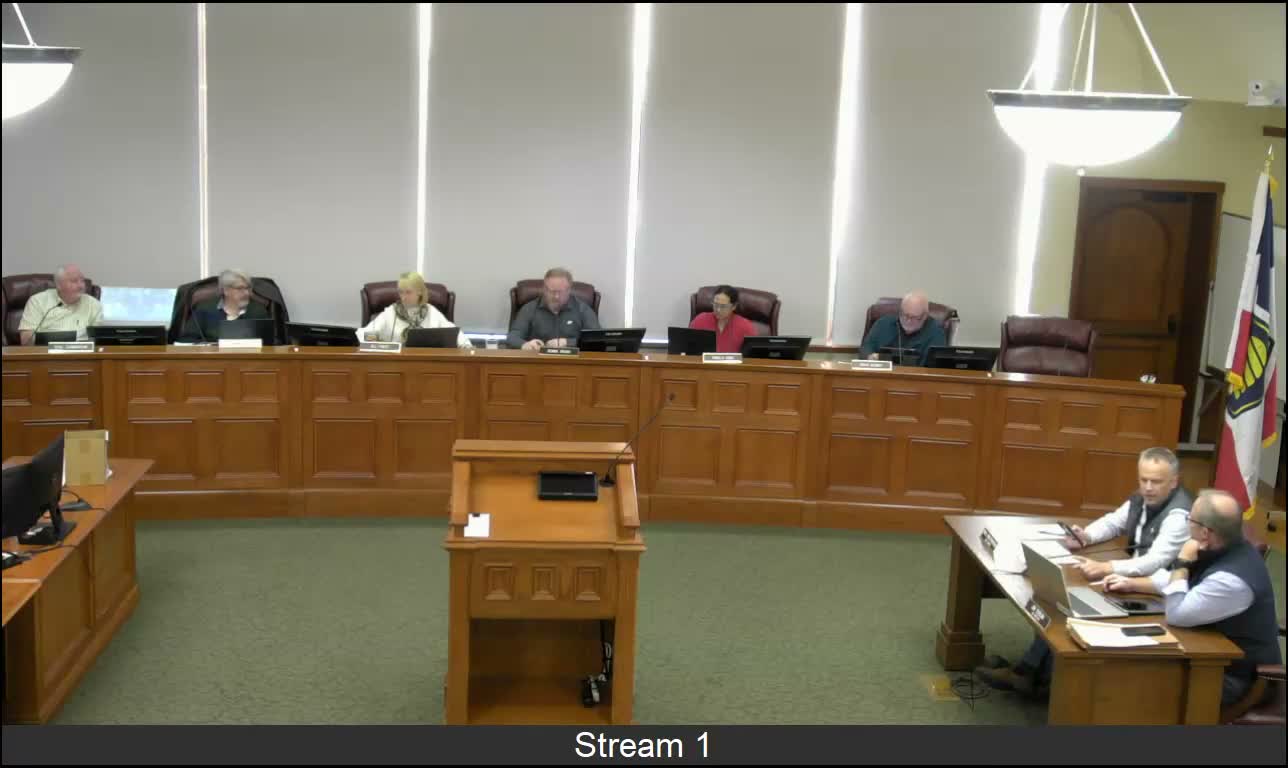
The Holladay City Planning Commission voted unanimously Oct. 28 to forward a recommendation to the city council to adopt a Wildland Urban Interface overlay boundary and related building-code requirements as part of statutory compliance with House Bill 48.
Staff said the state provided a map of structure exposure scores (SCS) and recommended jurisdictions adopt an overlay for areas at SCS 5 and above; the commission was asked to consider a staff-drawn dark-blue boundary that generally aligns with the SCS 5+ areas and to defer detailed study of a larger, light-blue zone. Captain Dan Brown of Unified Fire Authority described the SCS as a map-based indicator of wildfire exposure and told commissioners, "the state has recommended a structure exposure exposure score of 5 and above, for the wildland urban interface map for each jurisdiction." He added the SCS is location-based and that parcel-level assessments of materials and vegetation are a separate state process.
Why it matters: staff and UFA said adopting a boundary by Jan. 1 is necessary for compliance and to preserve eligibility for certain state emergency funds. The draft local text applies the WUI building-code provisions primarily to new construction, additions and substantial remodels, and it requires "defensible space" measures around structures. Staff pointed to the draft code's table that starts defensible-space distances at 30 feet and said specific setbacks and site adjustments may be applied by the local code official.
Residents at the meeting pushed for clearer answers on immediate consequences. Linda Lekman, who said she has lived at 6447 Canyon Crest Drive for 41 years, asked, "I have beautiful trees. Am I gonna have to cut down the trees?" Staff and UFA responded that routine day-to-day living would not change for most homeowners unless they pursue new construction or major remodels, but they acknowledged that defensible-space rules could require vegetation changes near structures and that enforcement and fee rules are not yet finalized by the state.
On the question of fees and insurance, staff repeatedly urged caution: the draft text does not impose local fees. Commissioners and UFA explained that the state will determine whether a separate, state‑assessed fee applies to specific high-risk parcels and that the city has no control over that assessment. Commissioners noted the state's fee rules (including thresholds for SCS levels that trigger assessments) remain pending and that a state public meeting is scheduled for Nov. 6 to discuss rulemaking.
The commission discussed mapping methodology at length. Staff said the state's raster maps are low resolution and bisect yards, so they proposed rounding boundaries to streets or block lines to make the overlay defensible and understandable. Staff also confirmed the overlay supplements — but does not replace — existing Foothills/Canyons overlay (FCOS) rules that govern lot splits and hillside development.
The commission approved a motion to forward the staff/UFA proposal to the city council (motion by Commissioner Cunningham; second by Commissioner Baron). The motion's findings cite alignment with House Bill 48 and UFA review. The roll call recorded ayes from Commissioner Cunningham, Tripp Trippany, Commissioner Fawn, Gonzales, Commissioner Baron and Chair Roach.
What's next: the planning commission's recommendation will be considered by the city council at a noticed public hearing; staff encouraged residents to attend the Nov. 6 state public meeting on rulemaking and to consult the building department for parcel‑specific questions. The city also said staff can meet one‑on‑one with property owners to explain potential site‑specific impacts.
Sources: Planning‑staff presentation, Unified Fire Authority briefing and public comments at the Oct. 28 Holladay City Planning Commission meeting.