Sweetwater Council approves future land-use amendment and updated zoning ordinance after public hearings
Loading...
Summary
After public hearings and staff presentations, the Sweetwater City Council approved an amendment to the 2022 future land use map and adopted an updated zoning land-use ordinance intended to align zoning with the city's comprehensive plan and add design, landscaping and nonconformity rules.
The Sweetwater City Council voted Feb. 10 to amend the city's 2022 future land use map and adopt a comprehensive update to the city's zoning land-use ordinance.
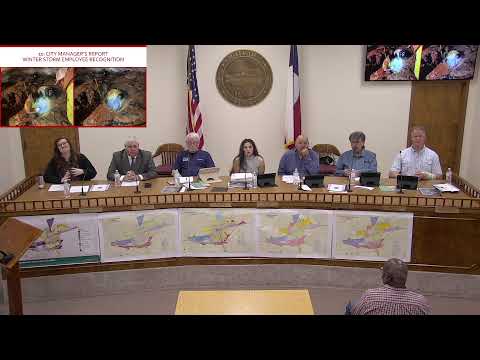
City planning staff told the council that state law requires zoning regulations to be consistent with the city's adopted future land use map and that proposed changes developed by the planning and zoning commission required an amendment to that map before a new zoning map could be approved. The council held public hearings on both actions before taking final votes.
Consultant Ashley, who led the zoning update presentation, said the ordinance creates a set of new base zoning districts (suburban residential, traditional neighborhood, neighborhood mix, neighborhood transition, downtown, general and regional commercial, light and heavy industrial, agricultural) and two overlay districts (gateway and infill). She outlined consolidated use tables that distinguish permitted, limited and conditional uses; new site and building design standards; parking and ADA rules; landscaping and buffer-yard requirements; and sign and lighting controls.
The update adds clearer procedures for development review, a consolidated applications table, and expanded definitions and measurement rules, Ashley said. She described new landscaping provisions including tree-preservation credits and an example buffer standard that requires a 10-foot minimum natural buffer with specified numbers of canopy and ornamental trees and shrubs.
Planning staff outlined how the planning and zoning commission conducted eight work sessions (four on the map, four on regulations), reviewed properties across the city, and recommended the package to council. Staff also explained the ordinance's approach to nonconformities: legally established uses and structures generally will be grandfathered; expansion is allowed in limited circumstances (staff described a roughly 50% expansion threshold tied to landscaping and other conditions); rebuilding after an "act of God" may be allowed up to 100% of a prior footprint, while other restorations may be limited to 75% of value within a one-year restoration period with case-by-case extension requests to the council or planning body.
On the record, council members who asked about future amendment processes were told that the future land use map and zoning ordinance can be amended in the future through the same public-notice and hearing process used for the current changes; staff emphasized the maps are not immutable. The planning and zoning commission's recommendation and staff concurrence were noted during the hearings.
After public comment opportunities produced no speakers on the items, the council approved the future land use amendment and the zoning land-use ordinance update by motion, second and voice vote. The mayor read the ordinances into the record citing Texas Local Government Code provisions pertaining to municipal planning and zoning.
The adopted changes provide the policy and regulatory framework the city will use to decide where different types of housing, commercial and industrial uses are allowed, how new development will be designed and reviewed, and how certain existing uses will be treated under the new rules.
The council did not identify any immediate additional implementation steps on the record beyond the standard publication and effective-date language read into the ordinances; planning staff will continue to advise on ordinance interpretation and review procedures.