Get Full Government Meeting Transcripts, Videos, & Alerts Forever!
Get email alerts on the Outcome Based Budgeting topic
No spam. Unsubscribe anytime.
Bloomington council holds deliberation on outcome‑based budgeting, adds environment as a priority bucket
Summary
Council members met Dec. 10 to continue work on an outcome‑based budgeting process for the 2027 cycle, agreed to add an 'environment' outcome category, and conducted an exercise to surface top priorities in housing, economic development and government performance.
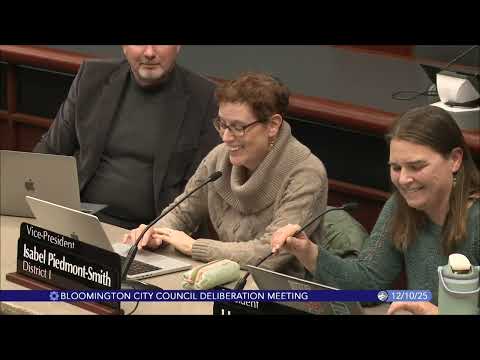
The Bloomington Common Council met Dec. 10 in a deliberation session focused on moving the city toward outcome‑based budgeting for the 2027 process and on identifying top priority outcomes, council leaders said. The meeting included staff briefings, a council ideation exercise and a brief public‑comment period.
Council member Piedmont Smith, who chairs the special fiscal committee, framed the approach as a three‑step logic: identify the outcomes the city wants to achieve, map programs that will deliver those outcomes, and then determine program costs. "The council passed a resolution in June 2024 regarding this," Piedmont Smith said, citing the council's prior direction to move toward outcome‑based budgeting.
Deputy Mayor Gretchen Knapp told the council the city's accounting software requires a top‑level category, which means it is feasible — and in some cases necessary — to create a discrete climate or environment category in the budget system. "The way the accounting software is set up, you do have to have a top level category," Knapp said, adding that staff have begun splitting some program lines to make tracking easier.
On procedure, some council members pressed caution about the limits of the first year of the effort. Council member Flaherty said the priority‑based step used for the 2026 budget reduced narrative detail and, in some cases, transparency. "I didn't find much usefulness for the buckets of categorization in a priority based budget framework this year," Flaherty said, urging attention to both measurable outputs and the time cost to staff of tagging expenditures.
After discussion, council members expressed support for adding an environment bucket. "No one said that environment should not be added. So environment is the seventh bucket," stated President Stossberg during the meeting. Deputy Mayor Knapp had told members it is straightforward to add a climate/category header and that staff have begun work to enable more granular program tracking.
Council members then moved through ideation for three focus areas during the session. Under housing and homelessness, members proposed outcomes such as increasing affordable, universally designed housing; improving neighborhood access to amenities; speeding permitting or approvals for projects that meet code; and the heading‑home plan target to "make homelessness rare, brief and non‑repeating." On government performance, members discussed inclusive engagement, responding to community survey results, and creating the capacity and financing mechanisms to implement and measure plans. Economic development ideas included improving downtown vitality, supporting arts and culture, and fostering "vibrant third places" or neighborhood hubs.
Public commenters urged the council to pair priorities with actionable performance measures and to use department data and dashboards. "Outcome based budgeting only works if the city has a precise understanding of which costs are locked in," said Kevin Keough, an accountant who spoke during the Zoom public‑comment period, urging a small set of measurable key performance indicators for each prioritized outcome. Chris Riri of the Greater Bloomington Chamber recommended incremental progress and using existing department data as a starting point.
For the final portion of the meeting, council members completed a post‑it note exercise to record their top three priorities across housing/homelessness, economic development and high‑performing government; council members will use those results as a jumping‑off point for subsequent deliberations. The meeting record shows the council did not take a formal binding vote to adopt final priorities at this session.
The meeting also included scheduling announcements: a special session called by the mayor about the Hopewell development is set for 4 p.m. Monday the 15th in the Allison Conference Room; the council's last regular session of the year is scheduled for Wednesday the 17th at 6:30 p.m.
Note on date: the transcript lists the meeting as Dec. 10 but does not state a year; council members referenced a June 2024 resolution during discussion. The council did not complete final prioritization or adopt a formal ordinance at this session; staff and the fiscal committee were tasked with recording member responses and returning with follow‑up work.
What's next: council members said they expect to repeat and refine the prioritization exercise in future meetings and to ask staff to prepare more granular program‑level budget and performance data for subsequent discussions.