
Bill would let Vermont health commissioner recommend vaccines and shield providers from liability
Get AI-powered insights, summaries, and transcripts
Sign Up Free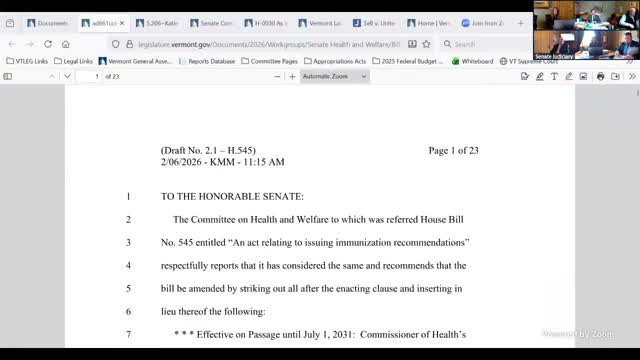
Summary
A Vermont Senate committee reviewed a draft bill that would allow the state health commissioner to issue vaccine recommendations independent of CDC guidance and would grant civil and administrative immunity to health care professionals who follow those recommendations except in cases of gross negligence, recklessness or intentional misconduct; the provision would sunset on 07/01/2031.
A Vermont Senate committee on Feb. 10 reviewed draft legislation that would let the Vermont Commissioner of Health issue immunization recommendations separate from the federal Centers for Disease Control and Prevention and would grant civil and administrative immunity to health care professionals who prescribe, dispense or administer immunizations in accordance with those state-issued recommendations.
Katie McDonough of the Legislative Council told the committee the 23-page bill “decouples that tie with CDC and instead authorizes the commissioner, the Vermont Commissioner of Health, to make recommendations on immunizations.” She said the provision at issue would take effect on passage and include a sunset date of 07/01/2031.
The draft establishes consultation rules for the commissioner, requiring consideration of input from the Vermont Immunization Advisory Council and professional organizations, including the CDC, McDonough said. The bill’s text also states that “a health care professional who prescribes, dispenses, or administers an immunization in accordance with the recommendations issued pursuant to [this section] shall be immune from civil and administrative liability for immunization-caused adverse events unless the health care professional’s actions … constituted gross negligence, recklessness, or intentional misconduct.”
McDonough said the intent is to protect clinicians who are acting within their scope of practice and following the commissioner’s guidance while preserving liability exposure for conduct that rises to gross negligence, recklessness or intentional misconduct.
Committee members asked how the state shield would interact with federal programs. McDonough explained the federal Vaccine Injury Compensation Program is a separate process that can provide compensation without traditional tort litigation and that many immunizations previously recommended through the CDC remain covered by that federal program. She cautioned that if the federal program’s coverage changed and those vaccines were removed, pharmaceutical manufacturers might lose any federal shield, while the draft statute would still protect Vermont providers who followed commissioner-issued recommendations.
On the question of suing state officers, McDonough summarized guidance from an attorney memo: the Vermont Tort Claims Act provides a limited right of action with statutory caps (she cited $500,000 per individual and $2,000,000 per occurrence) and includes an exception for discretionary policy decisions, which can make it difficult for plaintiffs to recover against state officers acting under statutory authority.
Jessica, identified only as a policy director at the Department of Health, told the committee that several states are working on similar language and that many states are considering giving broader authority to state health departments to make immunization recommendations “in addition to the federal government.” She confirmed the department currently issues recommendations and has followed CDC guidance to date.
Committee members raised other questions, including whether the language already exists in other states and whether the new language would change existing protections for providers when following CDC recommendations. McDonough said she would research whether other states have comparable liability language. No formal vote was taken; committee members conducted a straw poll and agreed to provide an answer to Senator Sarah Lyons later in the week.
The committee’s deliberations focused on balancing provider protections with avenues for harmed patients to seek redress, and on whether state-level authority could create coverage gaps if the federal compensation regime were narrowed. The draft mixes immediate, temporary authority for the commissioner with a stated reversion of some rules to the status quo as referenced in the bill’s second half.