Get Full Government Meeting Transcripts, Videos, & Alerts Forever!
Get email alerts on the State Legislation topic
No spam. Unsubscribe anytime.
Board hears legislative update on school safety bill, NIL and property-tax debate
Summary
Board member Nally briefed trustees on state bills under consideration, including a statewide behavioral threat-management bill, a proposal to prohibit NIL payments to middle/high school athletes, and Governor DeWine's comments on property-tax elimination and possible sales-tax increases.
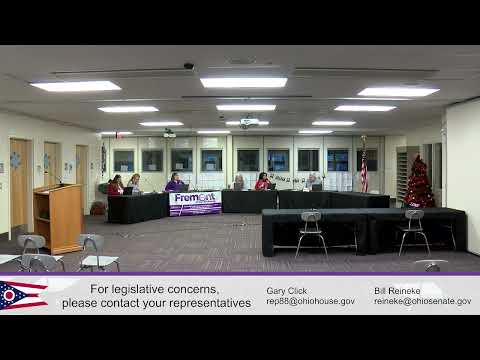
At the Fremont City Schools board meeting, board member Mister Nally provided a legislative briefing that highlighted several state-level proposals he said could affect local districts.
Nally noted a bill he identified as House Bill 189 that "establishes a statewide behavioral threat management operational process for public and chartered schools," and he said the measure raises questions about whether the legislature or local districts are best positioned to set operational threat-management procedures. He recommended that guidance, rather than a binding law, might better suit districts with local experts.
Nally also discussed a bill he called House Bill 661 that would prohibit middle- and high-school athletes from earning compensation for the use of their name, image or likeness (NIL). "It's to prohibit a middle or high school athlete from earning compensation from the athlete's name and image or likeness," he said, and the board briefly discussed concerns about who would pay and how the policy would be enforced.
On broader fiscal policy, Nally summarized public remarks by Governor DeWine opposing a proposal to eliminate property taxes, saying the governor warned that the state would still have to find alternative funding and suggested sales taxes could rise substantially. Nally said such a shift could significantly affect low-income households.
The board did not take action on any of these items; the briefing was informational. Members asked questions and expressed views about local control and the practical implications of state-level mandates.