Get Full Government Meeting Transcripts, Videos, & Alerts Forever!
Get email alerts on the Reciprocity Temporary License topic
No spam. Unsubscribe anytime.
Committee backs sending reciprocity and temporary‑license proposal to full board
Summary
The Licensing Committee recommended that a conceptual regulation clarifying reciprocity and establishing a temporary licensure path (with public notification and practice restrictions) be brought to the full board for January, after committee discussion about the proposed 5‑year practice requirement and implementation details.
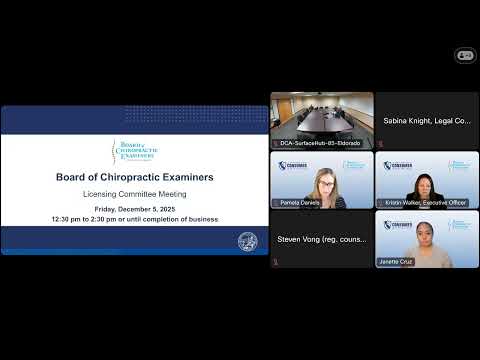
The Board of Chiropractic Examiners Licensing Committee on Dec. 5 recommended that a draft regulatory proposal clarifying requirements for licensure by reciprocity and creating a temporary license for out‑of‑state practitioners be forwarded to the full board for consideration.
Staff presented conceptual language that would require applicants seeking reciprocity to meet the same California curriculum requirements as other applicants but allow a temporary license for an applicant who holds an active, unrestricted out‑of‑state license, who graduated from a board‑approved program and who has passed NBCE parts 1–4 (or an equivalent). In the draft, staff proposed limiting temporary licenses to applicants who have ‘‘been actively licensed and practiced in another state for at least 5 of the past 7 years immediately preceding the submission of the application.’’
Why it matters: The proposal is intended to balance public protection, by ensuring applicants meet California curriculum standards, with reduced barriers to practice for licensed out‑of‑state chiropractors. It would also create public‑notification requirements for temporary licensees and practice restrictions for applicants missing specific coursework.
Committee discussion focused on the 5‑year practice requirement. Several members worried the requirement could create unnecessary barriers for recent graduates or people who relocate; others noted a multi‑year practice threshold could help guard against circumvention of California curriculum standards. Committee members asked staff to consider alternatives (for example a shorter time period, basing a requirement on residency duration, or broadening temporary licensure to all graduates who meet minimum requirements and then require them to remedy deficiencies while practicing).
Motion and outcome: The presiding member moved to recommend the regulatory proposal — incorporating the committee discussion about practice‑requirement options and other edits — be considered by the full board at its January meeting. The motion was seconded and passed by roll call (Doctor Daniels: yes; Ms. Cruz: yes). The committee directed staff to prepare pros/cons for alternative approaches and to add language clarifying how applicants move from temporary to permanent licensure.
Next steps: Staff agreed to refine the draft (including closing the loop on how deficient items are submitted to obtain a full license), evaluate whether the 5‑year measure should be justified or modified, and present updated materials to the full board at its January meeting.