Get AI Briefings, Transcripts & Alerts on Local & National Government Meetings — Forever.
Titusville CRA staff outline CPTED program, offer free surveys and park events
Loading...
Summary
City code enforcement officers described Crime Prevention Through Environmental Design (CPTED) principles, said the city offers complimentary residential and site assessments, and promoted outreach events including a February moon‑themed event and a March 14 popup at Blanton Park.
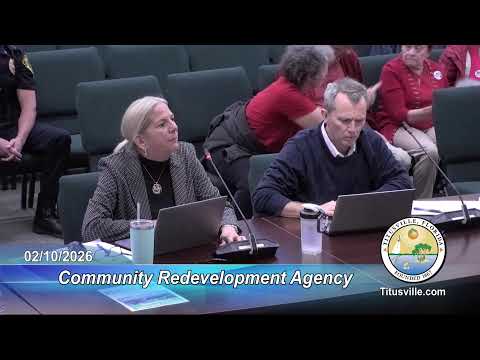
Megan Laurentio and May Wright, Titusville code enforcement officers, told the City of Titusville Community Redevelopment Agency on Feb. 10 that the city is using Crime Prevention Through Environmental Design, or CPTED, to improve safety in public spaces.
CPTED, the presenters said, relies on five strategies—natural surveillance, territorial reinforcement, natural access control, social management and maintenance—to reduce opportunities for crime and improve quality of life. "CPTED is, crime prevention through environmental design," a presenter said, describing how lighting, sightlines and landscaping can make users feel safer. "We have fencing that allows for natural surveillance so people could see in, they could see out," Laurentio added.
The officers described two complimentary services: residential security surveys, which offer targeted recommendations to homeowners, and holistic CPTED site surveys that include daytime and nighttime assessments and lighting surveys. They said the city maintains a story map (accessible via a QR code) where residents can request assessments and find contact information. The presenters emphasized the services are confidential and free of charge.
They also outlined outreach plans aimed at activating public spaces. The presentation noted a moon‑themed community event later in February (the transcript date was unclear) and a March 14 popup at Blanton Park featuring a free helmet giveaway and a static display from the police department. Asked about turnout at a prior park pop‑up, Laurentio said the event produced about nine helmet fittings and she estimated roughly 20–25 people passed through during a two‑hour outreach.
The presentation included an offer for CPTED training for community groups and stakeholders and suggested the program’s work is currently focused on city projects and parks, with a limited number of private surveys each year. Board members thanked the presenters and encouraged wider promotion of the free services.
The CRA did not take formal action on the presentation. Residents who want more information were directed to the city’s CPTED resources and contact information referenced in the story map.