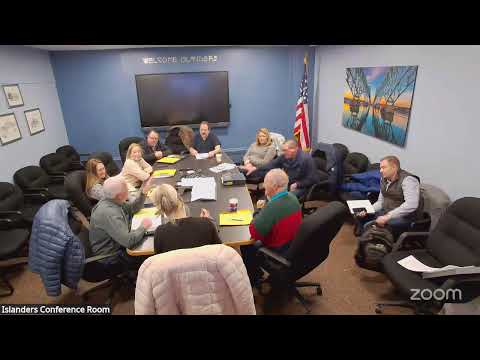
Grand Island planning board grills developer on battery storage safety, delays final solar-law edits
Loading...
Summary
Developers briefed the Grand Island Planning Board on proposed battery-energy-storage rules; members pressed for decommissioning assurances, annual operation reports, setback/screening limits and fire-department coordination and agreed to await Bridgette’s redline at a joint town-board meeting.
A developer who identified himself as Eric told the Grand Island Planning Board on the evening of the meeting that battery-energy-storage systems are typically sited, permitted and operated with host‑community agreements, emergency-action plans and vendor test data but that safety review is largely site‑specific. The board repeatedly pressed for clearer, mandatory requirements on decommissioning costs, operation reporting and firefighting coordination.
The substance of the session centered on what the draft battery law should require before a special-use permit is issued. Norm (S6) asked that applicants be explicitly required to pay for decommissioning inspections and testing and to post escrow funds so the town can hire outside experts for technical review. Eric said those provisions are common practice and that developers also propose annual operation and maintenance reports and a remote thermal‑monitoring alarm for local fire departments.
Board members pressed technical concerns. Members asked how long a battery fire burns and how much water would be required. Eric and other speakers described that smaller thermal‑runaway events often subside within roughly 4–6 hours, while larger incidents can be longer; the draft technical appendix cited an operational‑response scenario that referenced a 30,000‑gallon on‑site water supply and drafting capability of 1,500 gallons per minute for multi‑day operations. Consultants at the meeting said responses are typically defensive—containing spread and cooling surrounding vegetation or structures—rather than immediately extinguishing the battery cells.
Members also debated siting and screening rules. One board member said proposed evergreen screening could create a fire hazard; others recommended opaque fencing or vinyl screening with offsets from vents. The draft included a setback note that participants flagged as inconsistent (a 1,050‑foot figure appeared in one section and a proposed 1,000‑foot statute was discussed). Eric stated that a state 1,000‑foot setback was only the subject of a proposed bill and not adopted law, and he urged a performance‑based, site‑specific approach rather than a blanket setback.
Other technical recommendations discussed included requiring manufacturer certification and system‑specific test reports (UL 9540A or equivalent), PE‑sealed engineering drawings, HVAC/cooling system specifications, noise analysis (vendor data cited roughly 70 dB at 3 meters and a proposed code limit of 6 dB above ambient at the property line), and proof of a removal plan tied to fileable escrow or lease terms so units are not abandoned at end of a short lease.
The board did not vote on the battery law. Members asked staff to circulate a redlined draft prepared by the town’s consultant, Bridget/Bridgette, and scheduled a joint meeting with the town board (referred to in the meeting as the '20 sixth' at 05:00) to reconcile comments before any final drafting. Eric offered to prepare written answers to outstanding technical questions and to provide the detailed technical appendices the board requested.
What’s next: the planning board will compile written recommendations and review Bridgette’s redline at the joint meeting with the town board before taking further action.