Get email alerts on the Infrastructure Sewer topic
No spam. Unsubscribe anytime.
Albany updates completion timeline and costs for combined‑sewer separation program
Summary
City staff told the Albany City Commission that Phase 1 of the combined‑sewer separation program is effectively complete in the field, with remaining closeout paperwork and change orders to be finalized; staff cited roughly $136 million in construction costs and said the work was designed to a 10‑year storm standard.
Jeff Duplantis, the program manager for Albany’s combined‑sewer separation program, told the City Commission that in‑field construction is substantially complete for Phase 1 and that staff are finishing contract closeouts and as‑built documentation.
“We’re, you know, at about a $136,000,000 of construction that’ll be completed,” Duplantis said during the commission’s Nov. 5 work session, adding that final contract change orders and paperwork will push some figures higher when finalized.
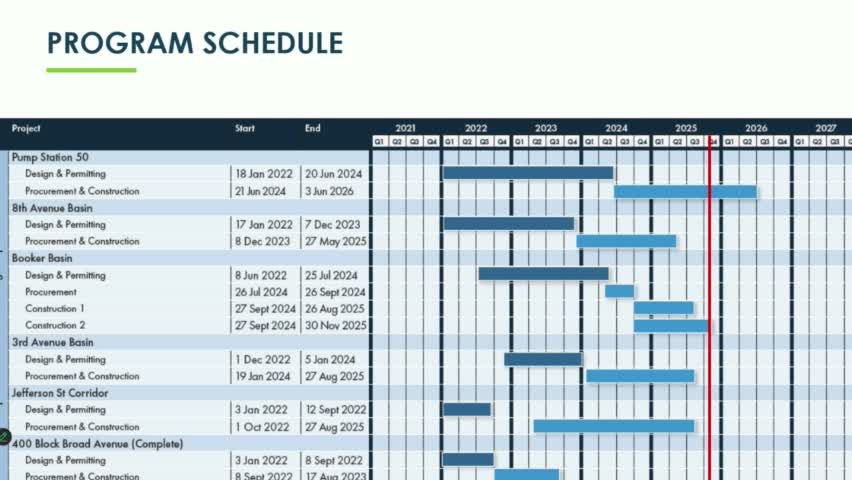
The presentation traced the program’s scope—separating storm and sanitary systems, rehabilitating pipe and lift stations, and upgrading components at the wastewater treatment plant—and identified remaining work that will extend into 2026 and beyond, including a Phase 5 pipe‑rehabilitation package and treatment‑plant projects that are scheduled to roll into early 2027.
Commissioners pressed staff on the level of flood protection the project provides. Duplantis said the design criteria were set to address a 10‑year storm event and cautioned that larger events (100‑year or greater) could still produce localized flooding.
Mayor Bo Dorough and other commissioners asked for a written copy of the presentation and a detailed funding spreadsheet showing sources, amounts spent to date and any remaining gaps. City staff agreed to provide hard copies of the program schedule and a list of funding sources and to return to the commission with any updated totals once change orders are finalized.
The presentation also noted the program’s federal oversight: staff said the work was completed to meet permit and consent‑order deadlines and thanked state partners with the Environmental Protection Division for cooperation. Commissioners suggested staff prepare a public‑facing explainer on how the project was funded and why the chosen design criteria were used.
Next procedural step: staff will supply the commission with the requested funding breakdown and a final closeout update once outstanding contract items are resolved.
AI generated
The text on this page is AI generated. Summaries, highlights, analysis, and video transcripts are all produced from the original source material.
AI can make mistakes, so if you spot one, and we will fix it for everyone.
Note: the source content is unaltered by us. Any content source we link to, be it a video, an audio recording, or a document, is presented exactly as its publisher released it. That publisher is usually a government body, sometimes an individual official or another organisation.