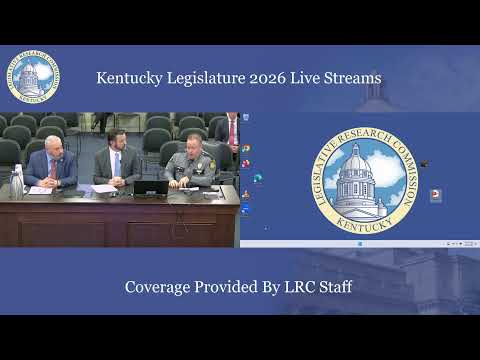
Providers tell Kentucky committee reimbursement rates haven’t kept pace with inflation, urge rate increases

Kentucky Legislature — Public Safety & Judiciary Subcommittee · February 11, 2026

Get AI-powered insights, summaries, and transcripts

Subscribe
AI-Generated Content: All content on this page was generated by AI to highlight key points from the meeting. For complete details and context, we recommend watching the full video. so we can fix them.

Summary

Department of Corrections and halfway-house providers told the legislature that contracted residential reentry beds and Recovery Kentucky centers serve thousands but reimbursement rates set in 2019 have not kept pace with inflation, leaving providers short-staffed and financially ‘strapped.’

At a Feb. 11 Public Safety and Judiciary Subcommittee meeting, Department of Corrections Deputy Commissioner Hillary Daley and community provider leaders described the state’s halfway-house and Recovery Kentucky network, urged attention to reimbursement rates and offered to provide outcome data to the committee.

Daley told lawmakers the department contracts for up to 1,752 halfway-house beds and 780 Recovery Kentucky beds across 16 halfway houses and 13 Recovery Kentucky centers, and that in fiscal year 2025 there were 6,329 admissions to those programs. She said current average daily populations are roughly 1,041 for halfway houses and 494 for Recovery Kentucky centers and listed evidence-based programming available at many sites, including moral recognition therapy variants, New Directions and adult basic education.

“Placement will depend on treatment needs,” Daley said, describing Recovery Kentucky as more restrictive on admissions. She added that per‑diem rates have not been changed since 2019 and that DOC has requested rate increases in prior budget cycles but did not include a request in the current cycle because of the revenue forecast.

Barbara Strom, director of Community Transitional Services (CTS), described CTS’s operations and the gap between provider costs and reimbursement. Strom said CTS opened in 2009, serves men leaving prison who need substance‑use treatment and performs security, urine and alcohol surveillance, and case management to help residents secure employment and housing.

“We would just like to keep up with inflation. We are strapped. We cannot compete in the marketplace,” Strom told the committee, explaining that provider pay and supplies are primary cost pressures. Strom said her organization’s standard rate is $33.61 per day and that, by her calculation, an inflation‑adjusted equivalent since 2010 would be about $47.41 per day.

Strom described staffing challenges: DOC correctional officers’ 2022 wages were reported in the hearing at roughly $49,000–$64,000 a year, while equivalent provider counselor salaries were described as roughly $28,000–$35,000, making recruitment and retention difficult.

Former CTS resident Michael Byrd spoke in support of the program’s effectiveness, describing his recovery and current employment in ministry and crediting the program for his rehabilitation.

When lawmakers asked about recidivism and graduation statistics, Strom said she could compile and provide those numbers from state data but did not have them immediately at the table; the committee accepted the offer to follow up.

The committee did not take formal action at the hearing. Providers asked lawmakers to consider rate adjustments to help halfway‑house operators compete for staff and maintain services; DOC and providers offered to supply additional outcome and utilization data to inform the committee’s deliberations.

The subcommittee recessed without approving minutes because a quorum was not present.