Get Full Government Meeting Transcripts, Videos, & Alerts Forever!
Get email alerts on the Economic Development topic
No spam. Unsubscribe anytime.
Invest Atlanta reports $1.7B in 2025 investments; council seeks more targeted support for Southside neighborhoods
Summary
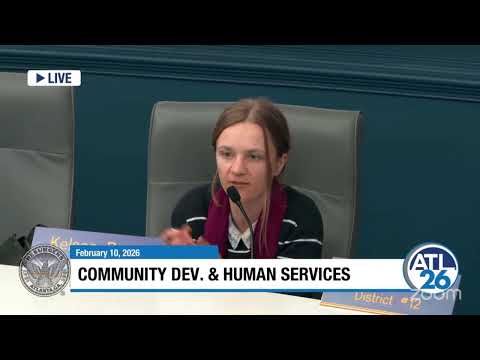
Invest Atlanta told the City Council committee it secured about $1.7 billion in capital investment in 2025 and high client satisfaction scores, while council members pressed the agency to ensure small-business attraction and TAD-funded projects benefit disinvested neighborhoods south of I-20.
Eloisa Clemente, President and CEO of Invest Atlanta, told the Community Development and Human Services Committee that Invest Atlanta's programs drove more than $1.7 billion in capital investment across 2025 and an estimated $5.4 billion in total economic impact. She said the agency's net promoter score for 2025 was 82.1 and its customer-satisfaction average was 4.6 out of 5.
Clemente highlighted affordable-housing investments (a 9.6% increase over 2024 and a 143.8% increase versus 2022), small-business support including more than $10 million in grants and loans and 954 one-on-one consultations, and Tax Allocation District (TAD) activity that closed 55 projects in 2025. She said roughly 62% of projects were located in neighborhoods Invest Atlanta identifies as disinvested and cited examples such as a 112-unit Mechanicsville affordable housing project, South Downtown streetscape work, and an $80 million mixed-use BeltLine development at Marietta Boulevard.
Council members used the presentation to press for specificity and accountability. Councilmember Antonio Lewis said maps showed homeownership and anti-displacement programs concentrated south of I-20, while business-attraction metrics appeared sparse there. "I just wanna say moving forward ... can we be more intentional with making sure some of the business development, business attraction funding is spent in the red areas?" Lewis asked. Clemente responded that Invest Atlanta monitors investments by neighborhood and offered to provide program-level breakdowns showing where projects and dollars were assigned.
Councilmember Isha Collins queried whether private dollars reported alongside TAD investments are flexible for targeted small-business support. Clemente said TAD dollars are constrained by state law to each TAD's geography; private investment figures reflect leveraged private capital in each project and are not generally transferable across TAD boundaries.
On job creation, Invest Atlanta said reporting requirements vary by program. "For some of the programs, yes, we do [track local hires], for some of the programs, I can't tell you," Clemente said, noting economic-opportunity agreements often require ZIP-code reporting while state opportunity-zone work does not.
The presentation also previewed Invest Atlanta's neighborhood metrics: anti-displacement tax-relief recipients, down-payment assistance numbers, and small-business improvement grants. Clemente said she would follow up with legal staff on whether legacy-business status could be given additional points in grant criteria and that Invest Atlanta was actively pursuing philanthropic support to expand legacy-business funding.
The committee did not take formal action on the presentation. Invest Atlanta committed to provide requested breakdowns by program and TAD geography to council offices and to follow up on the property-encroachment concern raised about a Mechanicsville parcel.