
Committee warned security contract rate gap could force fewer court days and closed buildings
Get AI-powered insights, summaries, and transcripts
Subscribe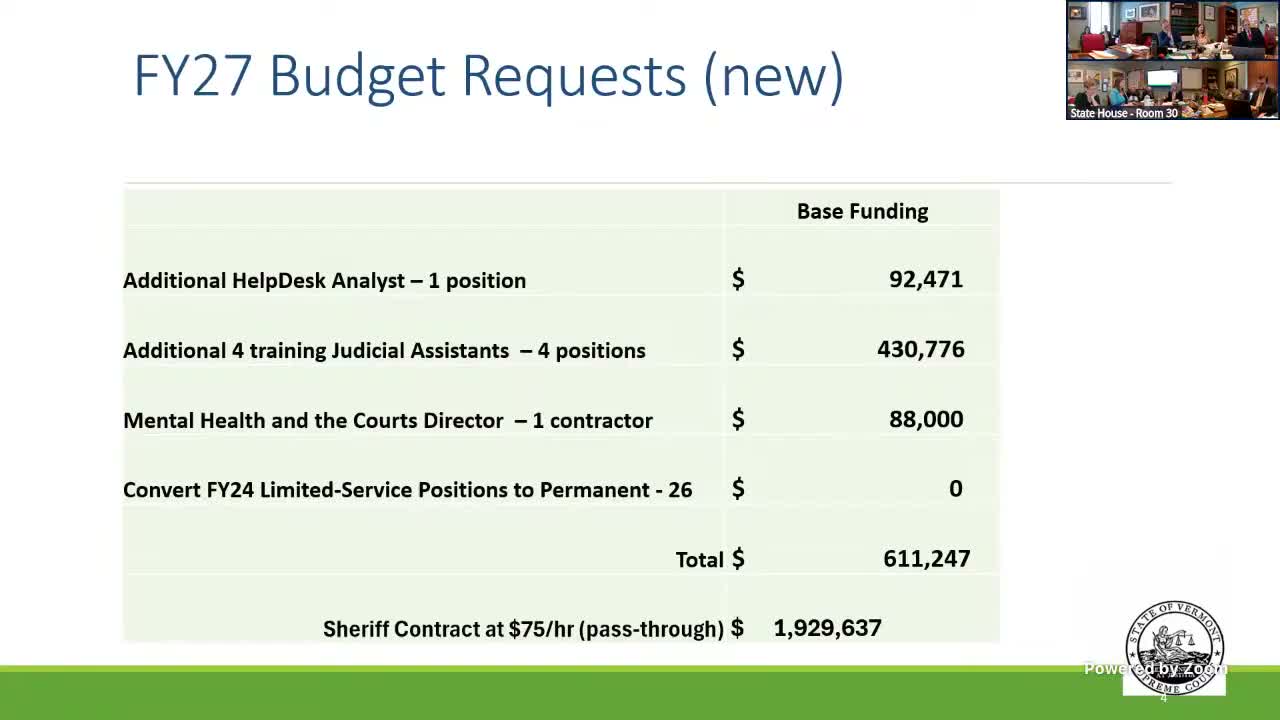
Summary
The committee was told Feb. 10 that rising sheriff contract rates and a mismatch between executive-branch and judiciary rates could reduce deputy availability, force courthouse closures on some days and increase budget pressure on the judiciary.
Members of the House Judiciary Committee were warned that negotiations over sheriff-contracted courthouse security rates risk operational disruption if the legislature does not address a widening rate gap.
Appropriations staff and Greg Mosley, the judiciary’s chief of finance and administration, said sheriffs currently receive about $57 per hour under existing judiciary contracts but are asking for $75 per hour — a rate reportedly in use for executive-branch contracts. Mosley told the committee that lower counteroffers (for example, $65 per hour) would constrain negotiations and could prompt some sheriffs to decline judiciary contracts.
‘‘Even going up to $57 an hour has caused a decrease in that service,’’ Mosley said, describing recent deputy retirements and recruitment challenges. He said one practical result has been limited opening hours in some court buildings; the Civil Building in Orleans County, for example, has been kept closed on most days because the assigned sheriff can no longer staff the contract due to turnover.
Committee members asked how a higher judiciary rate would be negotiated and whether the executive-branch contract terms are comparable. Mosley recommended negotiations through the chief procurement and finance contacts and noted that local sheriff departments decide deputy pay from the contracted sums.
The testimony flagged tradeoffs: paying a higher judiciary rate would increase court security costs (Appropriations estimated roughly a $2 million annual pressure to the judiciary budget), but paying less risks leaving courthouses understaffed and reducing court days in smaller counties. The committee asked staff to obtain executive-branch contract terms and the negotiating memo that explains how the $75/hour figure was derived.
The committee did not take formal action; staff and judiciary finance officials agreed to supply contract documentation to inform deliberations.