
Rockingham County Schools staff outline $6.8M potential state shortfall, warn of staff and building consolidation
Get AI-powered insights, summaries, and transcripts
Subscribe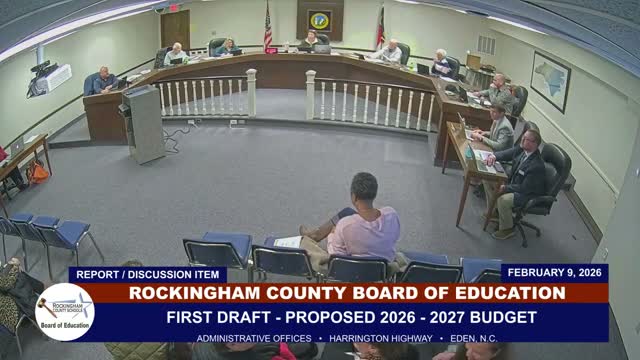
Summary
District finance staff told the school board the unresolved state biennium budget and falling enrollment could cut up to about $6.8 million in state funding for 2026–27, forcing position reductions, potential school consolidations and a $3.6 million shortfall in special-education funding that may require at least $1 million in local support.
Annie Ellis, presenting a high-level draft of the 2026–27 budget, told the Rockingham County Board of Education on Feb. 9 that a dispute between the North Carolina House and Senate over personal income tax rates has left the state without an approved biennium budget and created uncertainty for local schools.
Ellis said the North Carolina Office of State Budget and Management is projecting roughly $2,100,000,000 less in annual state revenue in the coming biennium compared with the higher-rate scenario; she said that projection could translate to approximately $6,800,000 less state funding for Rockingham County Schools in 2026–27. The district’s current best-of-two funding estimate is 10,740 students, down from the district’s funded count of 10,885, Ellis said, and the district has lost about 3,800 students over two decades.
“Because student population drives much of our funding, that decline already tells us we’re going to get less state money,” Ellis said, noting a mix of lower allotments and rising fixed costs — including retirement-matching increases, higher hospitalization costs and utility bills — that squeeze the local budget.
Ellis explained how shrinking allotments translate to positions: the projected state allotments equate to about 8.5 classroom teaching positions lost, one enhancement teacher position and two instructional-support positions, plus roughly $1,000,000 less in dollar allotments. She said those combined impacts are “probably close to $2,000,000” when positions and dollars are summed.
Ellis also warned that the district’s Exceptional Children (EC) funds are projected to face a $3,600,000 shortfall in 2026–27, noting EC fund balances that previously covered shortfalls are now exhausted. She said the district should plan to budget at least $1,000,000 in local dollars to help cover EC needs under the worst-case projection.
The finance presentation noted the district began the year with a $4.8 million local fund balance and has appropriated $1 million in the current budget, leaving a projected year-end balance of about $3.8 million. Ellis reminded the board that recommended reserves are roughly $2.4 million (about 1.5 months of county appropriation) and warned against exhausting the fund balance to mask recurring shortfalls.
Board members pressed staff on clarifying figures and next steps. Several asked whether consolidation of schools should be considered to reduce fixed costs; Ellis and other members said operating 24 buildings while serving a shrinking student population is a driver for examining consolidation. Board members requested staff bring options to a work session and to finance committee meetings for more detailed consideration.
Ellis said state planning allotments from the Department of Public Instruction were expected by late February; she outlined the immediate calendar for budget work: finance committee meetings in February (next on Feb. 11), a work session on Feb. 23 for line-item highlights, and bringing a final proposed budget for board approval on March 9 before presentation to the county commissioners on March 10. By state statute, Ellis said, the board must approve a budget by May 1 and submit it by May 15.
The presentation emphasized that many figures are projections and noted several variables — Medicaid billing, vacancies, and the ultimate state budget action — could change the outlook. Ellis said staff will provide more detailed line-item numbers at upcoming finance-committee meetings and at the Feb. 23 work session.
The board did not take a formal vote on budget reductions or consolidation at the meeting; members asked staff to continue developing options and to keep the public informed through committee meetings and board reports.