
Madison committee debates shrinking Common Council, focuses on resources and 3-1-1 update
Get AI-powered insights, summaries, and transcripts
Subscribe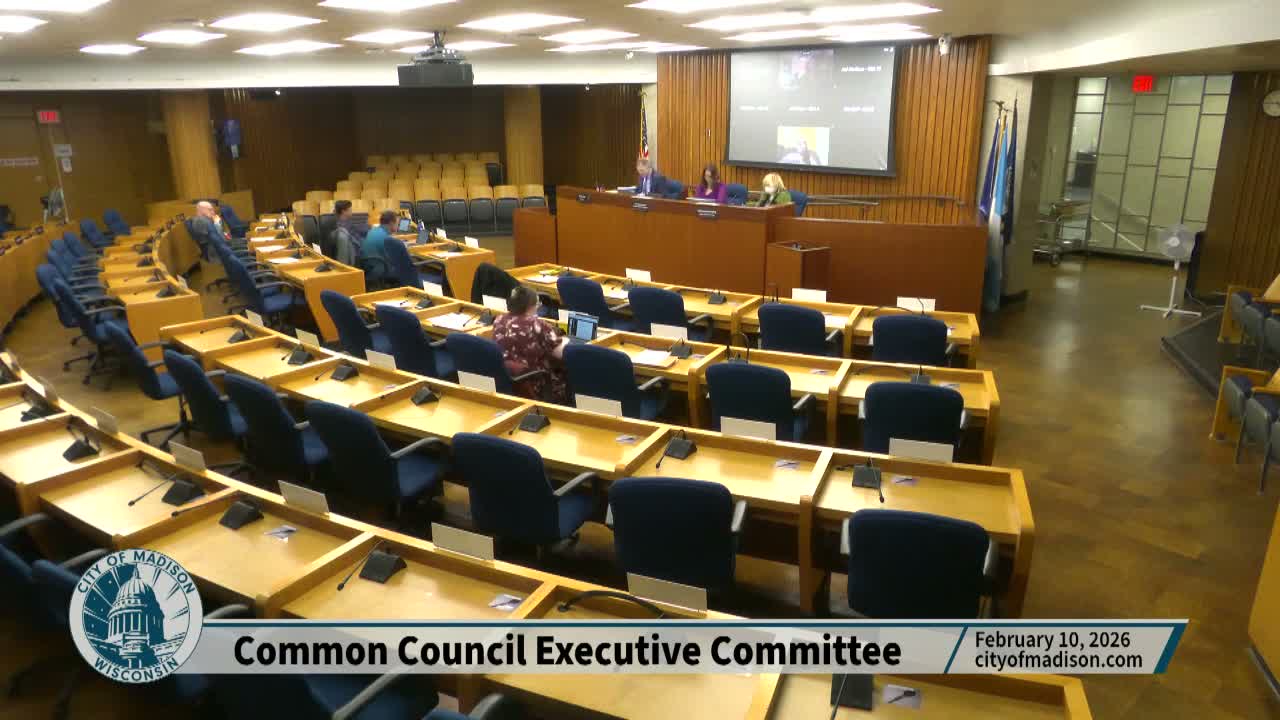
Summary
Madison’s Executive Committee discussed a proposal to reduce the Common Council from 20 members to a smaller odd-numbered body, but members did not vote and instead asked staff for research on 311, population projections, and examples from comparable cities.
Members of the Madison Common Council Executive Committee spent the bulk of their Feb. 10 meeting debating a proposal to reduce the council’s size, but the committee took no vote and instead asked staff to return with research and status updates.
The discussion centered on a memo outlining options to move from the current 20 alder structure to an odd-numbered body (examples discussed included 15 and 10 seats). Alder Ugair summarized the TFOG recommendation history and said the panel had once proposed 10 full-time alders paid roughly $62,000, and he presented arithmetic showing how per-alder compensation and constituents-per-alder would change under different scenarios. "Going to 15 would go up to 19,000 [residents per alder]; going to 10 would be 28,500," he said while urging caution about workload and the need for staff support.
Others warned of trade-offs. Alder Matthews said a smaller council would increase workloads and that modest pay bumps would not make the job effectively full time in many districts. "It would be taking on a good amount more work potentially with the additional constituents, and the additional money isn't really enough to be full time," she said. Alderman Arjan argued a reduction could risk eliminating the student seat that he said provides a needed perspective: "I think the fact that we have a student seat ... should not be lost at any cost." Several members said shrinking the council could reduce diversity and raise barriers for candidates who are not financially able to serve full time.
A recurring theme was resourcing. Alder Madison called the conversation "a very privileged conversation" and pressed for concrete documentation of what additional staff, tools or pay would be required for alders to serve effectively as the city grows. Multiple members and staff raised 311 — a centralized city services line and ticketing system — as a way to reduce constituent-service time for alders. Staff said the city has funded a 311 implementation but that technical and implementation work by IT remains.
Attorney Haas clarified legal mechanics: the size of the council would be decided by referendum while salaries are set by ordinance, so reducing the number of seats would not, on its own, automatically increase salaries. The committee’s chair summarized the group’s next steps: request a status update on 311 implementation, district-level population projections, examples from similar cities, and documentation of resource options (pay, staff, technology) for follow-up.
No ordinance or referendum was scheduled; members agreed to return the topic with the requested information.