
Guam committee hears bill to ban knowingly distributed AI deepfakes in elections
Get AI-powered insights, summaries, and transcripts
Subscribe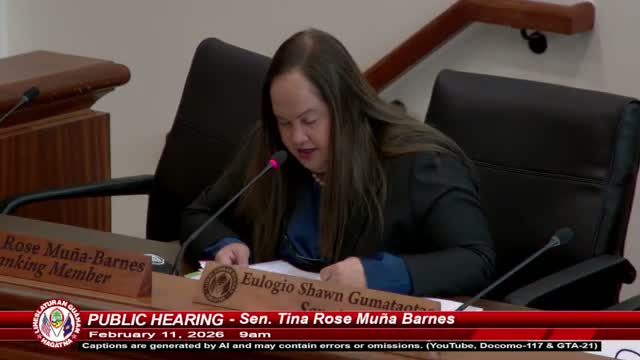
Summary
Senators heard testimony Feb. 11 on Bill 209-38, which would bar the knowing creation and distribution of materially deceptive AI-generated media tied to elections and require clear disclaimers; the Guam Election Commission urged clarifying that enforcement rests with the attorney general and courts.
Hagata1a, Guam ' Feb. 11, 2026 ' The Guam Legislature's Committee on Economic Investment heard testimony on Bill 209-38, introduced by Senator Tina Rosemary Barnes, which would prohibit the knowing creation and distribution of materially deceptive media produced by generative artificial intelligence in connection with elections.
"This is an act to prohibit the creation and distribution of materially deceptive media, generated by artificial intelligence," Senator Tina Rosemary Barnes told the committee, asking also that the committee consider a 90-day pre-election prohibition period to help the measure's clarity and defensibility.
The Guam Election Commission's representative, Sizouz Maase, read testimony that while the commission supports safeguarding election integrity it "takes no position for or against the policy merits of bill number 209-38" and urged clearer statutory text that enforcement and adjudication be assigned to the attorney general and the courts, not to the election commission. "Determination under the bill, such as whether media is materially deceptive ... are inherently fact specific and legal determinations appropriately reserved to the courts," Maase said.
Committee members raised practical and constitutional concerns. Senator Therese Cholahi told the committee that, as drafted, the bill appears to create civil and criminal liability without clear guidance on who first determines whether content is "materially deceptive," and warned that after-the-fact judicial remedies may be too slow "in the fog of an election cycle." She noted written testimony from the Office of Homeland Security pointing to similar constitutional and operational challenges.
Author Barnes and other supporters said the bill is narrowly tailored to target intentional deception during a defined pre-election period and does not ban political speech, satire, parody or bona fide news reporting. Sang Yong Kim, a visiting expert from South Korea who works on deepfake-prevention technology, offered oral support and said technical and educational steps are part of his approach to reducing deceptive AI misuse.
The committee did not take a vote. Chairwoman Senator Tello Tidygree closed the hearing and said written testimony will remain open for submission; sponsors and staff indicated they will seek additional input from legal counsel and the attorney general before markup.
What's next: The committee asked for any further written testimony and signaled it will coordinate follow-up with legal advisers to resolve the enforcement and statutory-clarity questions before any formal markup.