Get Full Government Meeting Transcripts, Videos, & Alerts Forever!
Get email alerts on the Public Health topic
No spam. Unsubscribe anytime.
Parish Mosquito Board backs U.S. Air Force training spray over Cameron Parish; jury agrees to run public notice
Summary
Mosquito-control officials proposed a U.S. Air Force–led hurricane-preparedness spray exercise across four parishes in September 2025; the jury agreed to allow the mosquito board to run the required public notice and learn public feedback before any final approval.
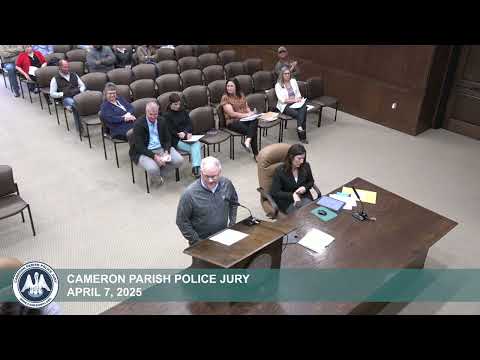
Josh Hightower, representing the Cameron Parish Mosquito Control board, told the police jury that state epidemiologist Kyle Hopper had worked with U.S. Air Force contacts to put together a proposed hurricane-preparedness training mission that would include Cameron Parish. Hightower said the plan, if approved, would simulate a multi-parish hurricane incident in September 2025 and cover up to 500,000 acres shared among four parishes; the mosquito board would supply chemical for ~125,000 acres.
"He could apply for a proposed project that could make Cameron Parish part of a training mission for United States Air Force," Hightower said, and asked the jury for permission to run the statutorily required public notice. He told jurors the process requires two successive advertisements followed by a 14-day comment period before a formal application can be filed.
Jurors and members of the public asked detailed questions about the spray. When asked what chemical would be used, Hightower replied, "It'd be, Diabrone, the same chemical that we use." He acknowledged the chemical "can kill bees" if sprayed at the wrong time of day, and said timing would be specified in later public notices. A question about crawfish impacts prompted Hightower to cite studies and say that diazinon/diabromel and malathion "are really the safest for crawfish" compared with some newer synthetics.
Officials also discussed aircraft operations. A juror asked what type of plane would be used; Hightower said a C-130 and estimated an operational altitude of "probably around 3 to 400 feet." He said the detailed information on aircraft, altitude and timing would be included in subsequent notices and outreach if the project proceeds.
The jury acknowledged the mosquito board's request and agreed staff should run the required public notice and report back. At the meeting, jurors emphasized public notification and a detailed follow-up notice that would include the specific chemical, timing and flight parameters if the exercise is approved.
Next steps: staff will post the two required public advertisements, accept comments during the 14‑day period, and then return to the jury with any public feedback before any application or airspace authorization is finalized.