Get Full Government Meeting Transcripts, Videos, & Alerts Forever!
Get email alerts on the Water Infrastructure topic
No spam. Unsubscribe anytime.
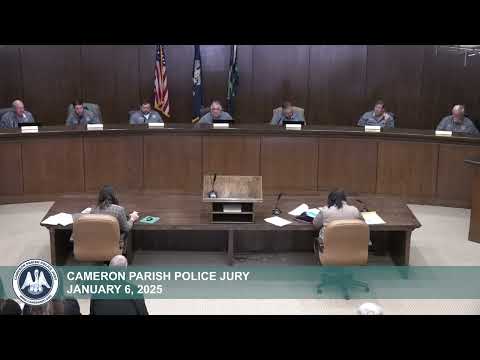
Cameron Parish approves splitting $350,000 CWEF grant among three water districts
Summary
The Cameron Parish Police Jury voted to divide a $350,000 Community Water Enrichment Fund allocation among three applicant water districts after staff presented audits and project needs, with follow-up application work to meet a February deadline.
Cameron Parish jurors voted Jan. 6 to split a $350,000 CWEF grant pool among three water districts that applied for funding.
Staff told the jury three districts — Grand Lake/Waterton, Hackberry and Johnson Bayou — submitted applications and outlined each district’s project and finances. "You have 350,000 in this grant," Speaker 5 said as staff summarized the applications and told the jury the CWEF application is due in February and awarded funds would have two years for expenditure.
Discussion identified the projects: Grand Lake is seeking storage-tank work and asked for $250,000 with a $50,000 local match; Hackberry and Johnson Bayou have storage- and well-related projects and asked for amounts described in the presentation (Johnson Bayou discussed as requesting $115,000). Staff noted some projects may be partially covered by FEMA but that matching requirements remain for some elements.
After considering district audits and the relative scale of projects, a juror moved to split the $350,000 three ways; the motion carried by voice vote. Staff will prepare the CWEF application and allocate funds according to the jury’s decision.
Speaker 5 also said that in the speaker’s 17 years of administering similar grants, funding was not allocated only one year, but cautioned that the legislature could decline to fund the program in a given year — a contingency staff flagged to the jury.
The jury’s allocation was procedural: staff will submit the application in February, and any ultimate award remains contingent on state funding and the formal CWEF award process. The jury gave direction to staff to return with any further details needed to finalize the application.