Get Full Government Meeting Transcripts, Videos, & Alerts Forever!
Get email alerts on the Conservation Easement topic
No spam. Unsubscribe anytime.
Commissioners condition US Fish & Wildlife conservation easement on drainage agreement
Summary
The Stevens County Board approved a perpetual conservation easement for roughly 157 acres offered by the U.S. Fish and Wildlife Service, but added a condition that a drainage easement with neighboring landowners be in place after debate over ditch maintenance and DNR water-control elevations.
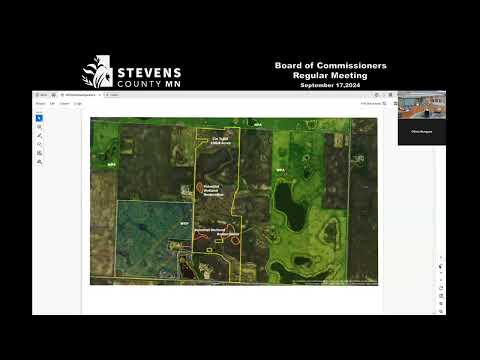
The Stevens County Board of Commissioners approved a perpetual conservation easement offered by the U.S. Fish and Wildlife Service for roughly 157 acres in Pappleton Township, but the board required a drainage easement with neighboring landowners as a condition of certification.
The easement proposal, presented by US Fish and Wildlife representatives, would leave land ownership and property taxes with the landowner while restricting management to conserve grasslands and wetlands for hunting, fishing and recreation. Speaker 5 said, “He will still pay his taxes,” and described the easement as a way to “make conservation easy” for the landowner.
Commissioners and neighbors raised concerns about drainage and long-term ditch maintenance. County and Fish and Wildlife staff said any wetland restoration would first require surveying and that the Minnesota Department of Natural Resources (DNR) sets a control elevation for the wetland outlet. Speaker 2 explained the DNR’s control elevation is currently about two feet higher than the ditch bottom and that DNR would likely require a water-control structure to bring the outlet to that protected elevation.
Neighbors and at least one commissioner pressed whether the Fish and Wildlife Service would permit future ditch-cleaning if sediment or cattail growth required it. Speaker 6 asked explicitly whether the agency would allow maintenance decades from now; Speaker 2 responded “probably not,” adding that federal review and precedent constrain what can be agreed. That disagreement prompted the board to seek a compromise to protect downstream landowners’ drainage rights.
Speaker 6 moved to approve certification of the easement on the condition that a drainage easement with the neighboring landowners be secured; Speaker 1 seconded. The board called the question and the motion carried.
What happens next: staff said any final easement and related documents must clear federal review and a government attorney before funding is exchanged. County staff said they would draft the conditional language and follow up with a letter seeking compromise language to attach to the certification.
Why it matters: The decision balances a federal conservation program’s technical constraints with local concerns about long-term drainage and road impacts. County staff warned that without a mechanism to ensure downstream drainage rights, the federal attorney might reject payment for the easement as an inappropriate use of taxpayer funds.