Get email alerts on the Renewable Energy topic
No spam. Unsubscribe anytime.
Stevens County board adopts standalone renewable energy ordinance after developer raises setback concerns
Summary
The Stevens County Board adopted a standalone renewable energy ordinance after a developer warned new setbacks could shrink viable project areas. The board discussed state preemption and rotor-size implications before voting to adopt the ordinance.
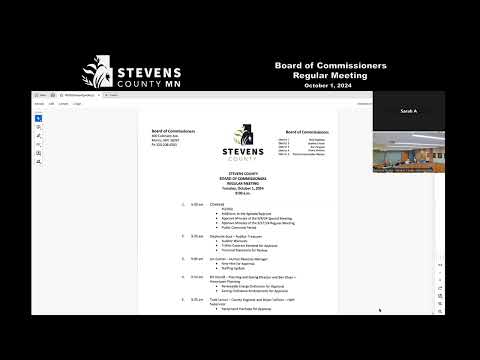
The Stevens County Board of Commissioners voted to adopt a standalone renewable energy ordinance after a discussion about setbacks, rotor size and state permitting authority.
County commissioners said the ordinance followed three work sessions and two public hearings. Commissioners and staff described the recent draft as largely editorially revised but revised in places to reflect concerns raised at previous meetings.
Sarah, a representative of Nova Energy who participated by phone, told the board she had not attended earlier public hearings and urged the county to allow additional time so the developer could show maps of proposed projects. "It didn't appear that evidence was produced," she said, adding that the proposed setback change "takes it from about, oh, 1,500 feet to about 2,400 feet," which she described as "a considerable jump." She said maps would help the board and the company find a setback both sides could accept and cautioned that larger turbine models were being contemplated but not yet selected.
Commissioners discussed the limits of county authority and the role of the Minnesota Public Utilities Commission. One member noted the state site-permit statute for Large Wind Energy Conversion Systems (LWECS) means the state permit often supersedes local rules but that the PUC is directed to consider local ordinances and may apply local standards unless it finds good cause not to.
Board members also debated technical bases for setback measures, such as using rotor diameter rather than fixed-distance formulas, and whether taking new testimony outside a formal public hearing was fair to parties who did not attend. After discussion, a commissioner moved to adopt the ordinance, the motion was seconded, the board called the question and the motion carried on a voice vote.
The board directed staff to publish a summary of the ordinance in the local newspaper; by statute and local practice the ordinance becomes effective after publication (staff said they planned to send summaries to the paper this week).
AI generated
The text on this page is AI generated. Summaries, highlights, analysis, and video transcripts are all produced from the original source material.
AI can make mistakes, so if you spot one, and we will fix it for everyone.
Note: the source content is unaltered by us. Any content source we link to, be it a video, an audio recording, or a document, is presented exactly as its publisher released it. That publisher is usually a government body, sometimes an individual official or another organisation.