Get Full Government Meeting Transcripts, Videos, & Alerts Forever!
Get email alerts on the Special Education topic
No spam. Unsubscribe anytime.
BCPS officials report progress on special education but flag continuing gaps in services and caseloads
Summary
Baltimore County Public Schools officials told the school board they have expanded special‑education staff and introduced new workload measures — including a 60–65 direct caseload target for speech‑language pathologists — but acknowledged remaining compliance work and pockets of high caseloads and vacancies.
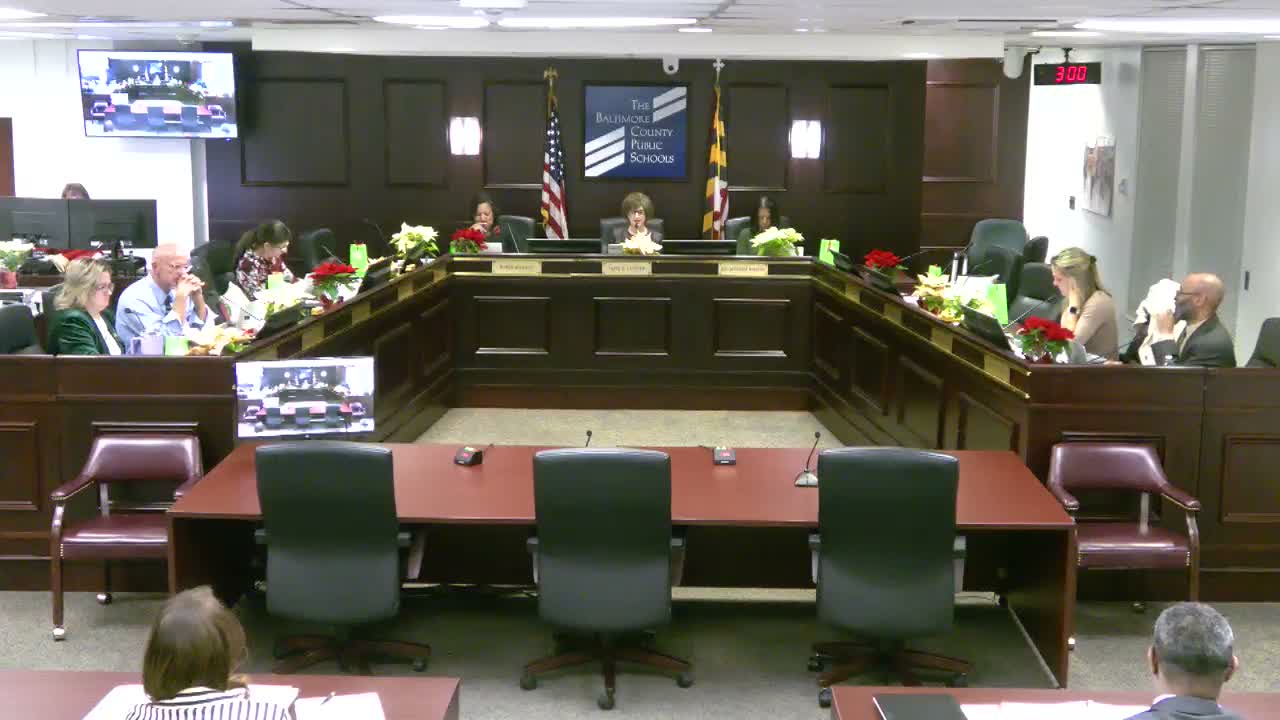
Baltimore County Public Schools special‑education leaders told the Board of Education on Dec. 16 that the district has increased staffing and changed service models to address rising student needs, while also continuing corrective work identified by state monitors.
The update — presented by special‑education staff and administrative leaders — outlined three priority areas: people (staffing and workload), services (access across levels and programs) and culture (family engagement and responsiveness). "Our vision for special education is outlined here that our expectation is for all children receiving special education services and their families and caregivers to feel accepted and embraced," the department said.
District officials said student needs have grown: more students are economically disadvantaged, multilingual learners and students requiring special education. To respond, BCPS has increased full‑time staff across special‑education roles and related services and introduced programmatic staffing that allocates positions by program sections rather than only by student counts so schools can accommodate in‑year growth.
A notable operational change is a direct‑service caseload target for speech‑language pathologists (SLPs). "We would have a direct service caseload target of 60 to 65 students for our speech and language pathologists," staff said, adding that the number was developed after consultation with national standards and peer jurisdictions. The district identified eight schools that will receive interim 0.2 FTE support (the equivalent of roughly one additional day per week from a virtual provider) while hiring continues.
BCPS officials described a hybrid service‑delivery model that mixes in‑person and virtual providers and emphasized the facilitator role at the school site. "The key component being the support of the other human that's present as they're accessing the virtual service," staff explained, adding that trained facilitators or staff are present during virtual sessions to provide materials and immediate support.
On the accountability front, the district said it has been engaged in regular monitoring with the Maryland State Department of Education (MSDE). Officials reported meeting requirements in 63 of 87 monitored sub‑indicators and showing improvement in 11 of the remaining 24; preschool/infant programs remain in a needs‑assistance category. To address monitoring findings, BCPS updated its IEP template, added signature‑receipt reports for chairs and expanded professional development and audit work to correct earlier deficiencies.
District leaders also highlighted family and community supports: a special‑education family support newsletter, parent workshops, a parent resource center and a new special‑education advisory group. "There are multiple ways to stay connected with our family support services," staff said, noting a tile on the BCPS homepage linking families to special‑education resources.
The presentation included service metrics: staff reported quarterly monitoring of SLP caseloads, expansion of assessment tools and progress‑monitoring reports, and said 18 community mental‑health partners currently have agreements with BCPS and are providing services in 86 schools; consortium dollars expand services in 127 schools. Officials said they continue to recruit in‑person staff, noting two SLP hires expected to start in January and February.
Board members pressed staff for more detail on implementation: how many SLPs remain above the target caseload, what supports virtual service facilitators provide, and how the district will ensure equity of access across ZIP codes and school sites. Staff said they monitor caseloads quarterly, use itinerant providers and contractors as stopgaps, and are building a management plan and monthly compliance reporting to principals.
The district described corrective‑action and escalation procedures: MSDE provides the sample and complaint lists, the district reviews trends and shares expectations with principals, and school‑level corrective steps are coordinated across departments. Officials noted that annual monitoring and the state performance plan (SPP/APR) provide public measures and that the district maintains a schedule of improvement plans for indicators needing work.
Next steps identified by staff included continued hiring, quarterly caseload reviews, ongoing collaboration with MSDE and targeted improvement plans for un‑met SPP/APR indicators. The board did not take formal action on these presentation items but directed staff to continue the monitoring and to provide updates on caseload implementation and hiring progress at future meetings.
Provenance: presentation and Q&A, Board of Education meeting, Dec. 16, 2025 (topic introduced at SEG 888; discussion and close of Q&A recorded through SEG 2951).