Get Full Government Meeting Transcripts, Videos, & Alerts Forever!
Get email alerts on the Charter Revision topic
No spam. Unsubscribe anytime.
New Canaan Charter Revision Group Reviews Article 5: Board of Finance, Pensions, WPCA and Audit Committee
Summary
Members of the Charter Revision Commission (Group 2) reviewed Article 5 of New Canaan’s charter on Feb. 9, discussing board composition, term limits, pension clauses for library employees, WPCA governance and whether the audit committee should be renamed. They agreed to further research several technical items before a final recommendation.
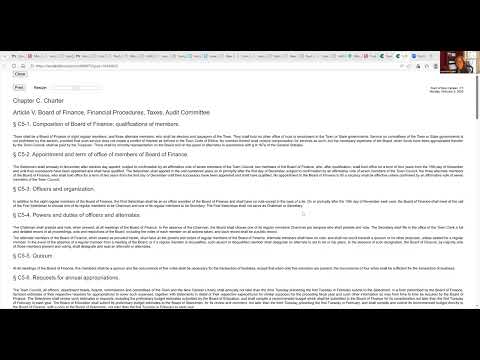
Kathleen Corbett, a member of the Charter Revision Commission (Group 2), opened a Feb. 9 Zoom meeting saying the group would focus on Article 5 of New Canaan’s charter — the provisions that govern the Board of Finance, financial procedures, taxes and the audit committee. Corbett called roll and named several participants and Board of Finance representatives who joined the discussion.
The session reviewed the Board of Finance’s composition and eligibility rules. Corbett read the charter language that sets eight regular members and three alternates and reminded attendees that, in an earlier revision, voters rejected a change that would have required board members to be property-owning taxpayers. As Corbett noted, the text still requires minority political-party representation: “there shall be minority representation, as defined under section 9-7a of the General Statutes,” meaning no single party can hold more than five regular seats (and no more than two alternates).
The commission also discussed terms and term limits. Corbett said regular members serve four-year terms and alternates serve two-year terms; participants debated whether to add term limits. Nick Matrakis, a Commission participant, urged caution about strict limits, saying, “the more experience somebody has, the better for the town,” arguing long-serving members provide valuable institutional knowledge. Others suggested compromises (for example, limiting consecutive terms) but the group did not adopt a change on the spot.
Pension provisions and the library clause drew focused attention. Corbett pointed out a prior change that extended pension eligibility to New Canaan Library employees employed before Jan. 1, 2011 and asked whether that clause remains necessary. Board members said there may still be retirees covered by the clause and recommended keeping the language until no beneficiaries remain; they also proposed adding charter text that explicitly references the pension subcommittees and the Retirement Pension Advisory Committee (RPAC), which manages investment hires and asset oversight.
Speakers clarified how pension matters are handled. Participants described two distinct bodies: a pension committee that reviews individual pension applications and an RPAC that manages investments and vendors. As one Board of Finance representative said, the pension subcommittee’s decisions are advisory and must be ratified by the full board, recommending the charter explicitly reference those subcommittees to avoid ambiguity.
The commission examined budget procedures in Article 5, including the format for department budget submissions and the board’s role in prescribing itemized estimates. Board members said departments use a long-established budget-book format that is not codified but functions effectively; the Board can tighten special-appropriation submissions when necessary. Corbett reiterated timing rules for the annual budget meeting (observed 11 weeks after the first Tuesday in February) and the requirement that notices be published once a week for two consecutive weeks.
The group discussed the charter’s limit on town-council power over appropriations. Under current language the town council may approve, disapprove or reduce recommended appropriations but may not increase them; Board of Finance members defended the restriction as preserving a disciplined budget screening process that aims to keep taxes low.
A substantive governance topic was the sewer taxing district and the Water Pollution Control Authority (WPCA). Board members explained WPCA functions as a separate authority with responsibility for sewer taxation and operations; several speakers recommended clarifying in Article 5 whether WPCA provisions should remain in the same article or be separated into their own charter article to improve governance clarity. One member suggested adding technical expertise (for example, engineering expertise) to WPCA appointments if the commission moves to revise governance structure.
The commission also reviewed audit-related language. Members discussed whether to rename the existing audit committee to "audit commission" or "audit board" to align with naming conventions used for other bodies and agreed to add definitions for boards, commissions and committees in the charter’s definitions section. Corbett indicated the group would correct a cross-reference to a penalty clause and confirmed that the town’s accounting follows GAAP and GASB standards.
No binding charter amendments were adopted at the meeting. The commission identified follow-up items — including whether to move WPCA text to its own article, whether library-pension language can be narrowed or removed once beneficiaries expire, and whether the audit committee’s name should be revised — and agreed to investigate those items and bring findings to the full commission. The meeting concluded after a motion to adjourn was made and seconded; the motion carried.