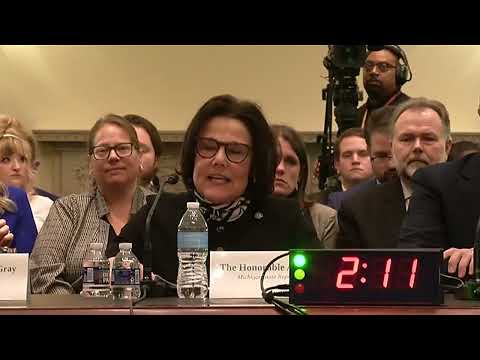
Michigan lawmaker urges House Administration Committee to adopt nationwide baseline election standards
Loading...
Summary
Anne Bolen, chair of the Michigan House Appropriations Committee, told the House Administration Committee that the MEGA Act would restore public trust by requiring photo ID, citizenship verification at registration, standardized audits, paper ballots with security features and stronger chain-of-custody rules, and by tying funding to compliance.
Anne Bolen, chair of the Michigan House Appropriations Committee, testified before the House Administration Committee in favor of the MEGA Act, arguing it would create clear, practical federal baseline standards to strengthen the administration of federal elections while respecting states' constitutional role.
Bolen said the proposal is aimed at restoring public confidence after the 2020 election and cited earlier federal measures as precedents: "After the extremely close presidential election in 2000, Congress passed the Help America Vote Act," she told lawmakers, adding that UOCAVA and the MOVE Act similarly provided baseline standards to support states. She also pointed to the Real ID process as an example of a nationwide identity-verification effort implemented "thoughtfully and effectively."
The Michigan lawmaker, who identified herself as a former local clerk with 16 years of election-administration experience and a former chair of the state House Elections and Ethics Committee, pressed several specific reforms the MEGA Act would promote. She said registration should include documentary proof of U.S. citizenship and that "registration should not be considered complete without this proof." On identification at the polls, Bolen cited public backing for ID requirements and called photo identification "a commonsense step" while urging that IDs be "current" and clearly defined.
Bolen also urged standardized list-maintenance practices, recommending cross-check verification managed by election administrators rather than third parties. She argued for standardized post-election and performance audits "to enable early identification of procedural shortfalls" and for paper ballots with numbered stubs printed with safeguards such as barcodes or watermarks to prevent fraud.
On voting modes and ballot integrity, Bolen said ballot and voter harvesting should be treated as serious offenses and recommended limiting in-person early voting while treating mail ballots as absentee ballots that require an application stating a reason and a wet signature. She advocated date- and time-stamping of applications and ballots by an election official and a thorough chain of custody to protect the integrity of recounts, canvass, certification and audits.
Describing elections as ‘‘key infrastructure,’’ Bolen said the MEGA Act could be paired with funding incentives to accelerate implementation: "Consideration of funding contingent upon compliance with the act accelerates its implementation," she said, adding that she supports adequate public funding for elections rather than reliance on third-party funds.
Bolen closed by urging a practical, apolitical approach to the bill and said she looked forward to answering committee questions. The testimony did not include a formal legislative vote or testimony from other witnesses; committee next steps were not specified in the record.