
Council defers three tree‑canopy land purchases amid appraisal and notice questions
Get AI-powered insights, summaries, and transcripts
Subscribe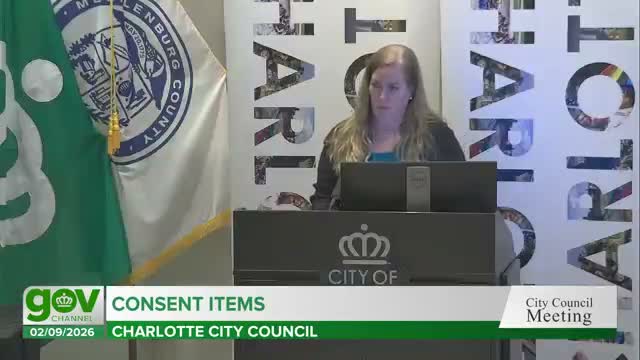
Summary
Charlotte City Council moved to defer three consent items (32, 33 and 34) that would have funded land acquisitions under the Tree Canopy Preservation Program, after council members asked for more appraisal detail, funding‑bucket clarity and broader notice to affected residents; staff said appraisals are recent and funds are developer fee‑in‑lieu dollars.
Charlotte City Council voted on Feb. 9 to defer three consent items — Nos. 32, 33 and 34 — that would have authorized land purchases under the Tree Canopy Preservation Program (TCPP) until the Feb. 23 business meeting.
Councilmember La'Juana Mayfield led the push to defer, saying she needed clearer justification for the purchase prices and broader community notice for affected unincorporated neighbors. Mayfield noted tax‑valuation figures she had reviewed and asked why market appraisals were so much higher; she also questioned whether residents outside the 300‑foot rezoning notice band would learn about hearings and construction impacts.
City staff said the numbers before council reflect recent market appraisals (not tax values) and that some structures on the parcels were demolished, so the purchase largely reflects land value. Tim Porter, the city’s chief urban forester, told council the TCPP is funded with developer fee‑in‑lieu dollars collected during permitting, not with the city’s general tax levy, and that conserved parcels are protected through conservation easements or similar legal mechanisms.
Staff and the council discussed timing: several of the purchase contracts include a short closing window (roughly 30 days in some cases), and staff said deferral could risk losing properties. Council members balanced that urgency against the need for transparency and additional detail; Greg Crawford (real estate) explained the appraisals used a “highest and best use” vacant‑land analysis and were reviewed internally and externally.
The motion to defer the items (moved by Mayfield, seconded by Councilmember Owens) passed, and staff agreed to return with appraisal dates, comparables and an updated accounting of available TCPP and housing trust funds.
Next step: staff will provide the requested appraisal dates, comparable sales and a funding‑balance update ahead of the Feb. 23 meeting so council can revisit the purchases with the additional information.