Get Full Government Meeting Transcripts, Videos, & Alerts Forever!
Get email alerts on the Animal Services Fees topic
No spam. Unsubscribe anytime.
Multnomah County adopts changes to animal-services fees, removes impound fees
Summary
The Multnomah County Board of Commissioners adopted a resolution updating Chapter 13 of county code on Multnomah County Animal Services fees after a fee study recommended modernizing licensing, boosting participation rather than raising prices, adopting variable adoption fees, and eliminating impound fees for lost or stray pets; the vote was unanimous.
The Multnomah County Board of Commissioners on a unanimous vote adopted a resolution to update county code governing Multnomah County Animal Services (MCAS) fees, including elimination of impound fees for lost or stray pets while retaining fines for dangerous or repeat infractions.
The board acted after a presentation of a five‑year fee study covering fiscal years 2021–2025. Erin Grama Heck, introduced in the meeting as director of Multnomah County Animal Services, told the board that the data show "we don't have a pricing problem. We have a participation problem,” arguing that outreach and modernization — not higher license fees — are the best way to improve reunification and public‑health tracking for rabies vaccinations. The study recommended four focus areas: licensing, adoptions, impoundment and boarding, and administrative cleanup of obsolete fees in county code.
Why it mattered: the study found licensing compliance in Multnomah County is well below industry benchmarks; raising participation through easier online licensing, advertising and partnerships with local veterinary clinics is expected to increase revenue by volume while improving pet reunification and rabies‑vaccine tracking. County budget staff noted that licensing fees are budgeted to and credited in the county general fund and that licensing revenue in the most recent year was on the order of $1,000,000; Multnomah County animal services is funded from the general fund (the program was described in the meeting as roughly a $12,000,000 general‑fund budget line).
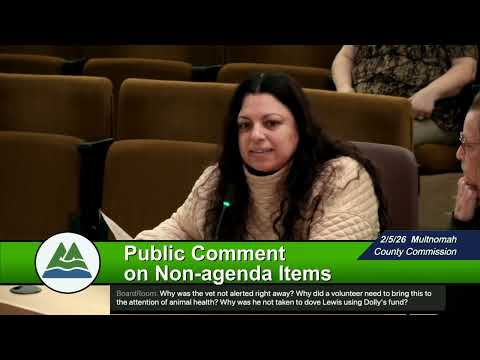
Public testimony included accounts from volunteers and advocates who pressed the board for improved medical staffing and transparency at MCAS. Anna, a public commenter who said she has appeared at past meetings, described several animals that she said were not timely referred to veterinary care and said, "This is medical negligence," and asked for accountability for named staff at the shelter. Janice Sten, identifying herself as a long‑time volunteer, recounted a case of a dog who showed progressive kennel stress and was later euthanized after rounds placed the animal on hold. Commenter Lightning supported eliminating impound and euthanasia fees and urged additional staff supports for volunteers and clinicians.
Board discussion focused on how the changes would affect reunification and public health, and on the distinction between fines (punitive) and fees (cost recovery). Legal staff and presenters clarified that Oregon law couples rabies vaccination and dog licensing at the state level, while the statute's requirements for cats differ; commissioners requested that attorneys follow up to confirm the exact distinctions between county code and state statute. Christian Elkins, the county budget director, told commissioners that fees are budgeted in the general fund and credited there; he confirmed licensing revenue was approximately $1,000,000 in the cited period.
Key decisions and next steps: the adopted resolution (R1) updates County Code Chapter 13 to modernize fee language, clarifies criteria for director waivers and adoption specials, endorses exploration of variable adoption fees to cross‑subsidize harder‑to‑place animals, and eliminates impound fees for lost or stray pets to reduce barriers to reunification. The board asked staff to return with implementation details and follow‑up numbers — including data on fee waivers, net fiscal impact, and a timeline for online licensing modernization (staff said exploratory vendor/IT work is underway and full implementation work is expected to proceed through the next year). The chair closed the item after roll‑call; the resolution was adopted.