Get Full Government Meeting Transcripts, Videos, & Alerts Forever!
Get email alerts on the Tirs Boundary topic
No spam. Unsubscribe anytime.
Liberty Hill DRC votes to recommend smaller TIRS boundary while keeping 50% participation
Summary
The Downtown Revitalization Committee voted to forward a reduced Tax Increment Reinvestment (TIRS) boundary to city council while keeping the current 50% participation rate, after hearing consultants' legal and revenue analysis and projected 10-year revenue scenarios.
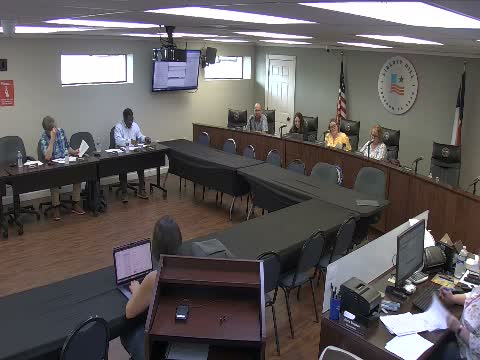
The Liberty Hill Downtown Revitalization Committee on Monday voted to recommend that the city council consider a reduced Tax Increment Reinvestment (TIRS) boundary while maintaining the city's current 50% participation rate.
Consultant Casey Sklar of P3 Works told the committee the TIRS was created in 2023 and carries a 30-year term and that state law caps residential use inside a TIRS at 30% based on current land use data rather than zoning. Sklar said two of three boundary alternatives shown to the committee in February failed the statutory residential-percentage test; the option the committee approved to forward was the smaller map that met the test at roughly 24.5% residential use.
Sklar walked the committee through revenue projections under the plan's buildout assumptions (about 25,000 square feet of commercial development per year at $150 per square foot; about 64 single-family homes per year; and a 2% annual growth assumption). Under the current 50% participation rate and the larger existing boundary, Sklar said the model shows roughly $2.2 million of tax increment pledged to the TIRS over 10 years. Dropping the participation rate to 25% in the model reduced the TIRS' share to about $1.1 million and raised the share retained by the city's general fund.
Committee members pressed Sklar on trade-offs. One member said she preferred to keep the 50% rate if a smaller boundary could preserve downtown investment; another asked whether large parcels could later become residential and jeopardize the statutory threshold. Sklar replied that the 30% test is a snapshot at the time a TIRS is formed and that later changes to land use do not automatically force re-formation.
The chair moved to forward the reduced-size map (the compliant map shown by Sklar) with the participation rate kept at 50% to city council for review; another member seconded. The motion carried on a voice vote.
The committee and consultant also discussed alternative options, including reducing the participation percentage, changing the TIRS term or eligible-project list, or dissolving the TIRS so increments flow directly to the general fund. Sklar said each choice simply reallocates future incremental growth between the TIRS fund and the general fund and that staff and council will ultimately decide which option to pursue.
Next steps: the DRC's recommendation will be transmitted to city staff and presented to the city council for their review and any formal action.
"So, I have for the record, my name is Casey Sklar. I'm with P3 Works, the city's tourism administrator," Sklar said during the presentation. "If you're reducing the boundary, you're missing out on any incremental growth from those parcels that you're pulling out."