Get Full Government Meeting Transcripts, Videos, & Alerts Forever!
Get email alerts on the Water System Overview topic
No spam. Unsubscribe anytime.
Engineer walks council through 'water 101' including usage spikes and planning metrics
Summary
City engineer Jennifer Glace presented a broad overview of Liberty Hill's water distribution system, explained pressure and storage concepts, and shared usage data showing a July 2022 peak near 400 gallons per day per residential connection and an estimated winter low near 150 gpd.
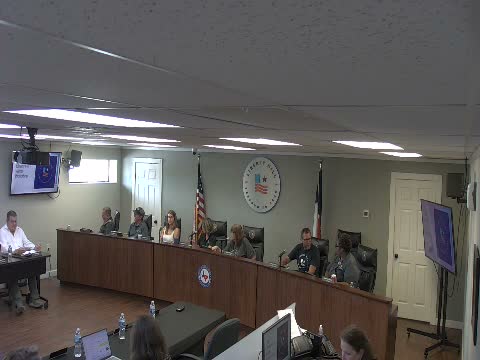
Jennifer Glace, identified in the meeting as the city’s engineer, gave a technical overview of the city's water distribution system and current usage patterns during a special council workshop.
Glace reviewed supply options (reservoirs and groundwater), storage and distribution basics and the two primary ways to maintain system pressure: gravity from elevated tanks and pumps with hydro‑pneumatic systems. She explained that elevation differences and pipeline diameter both influence pressure and flow at customer taps and described how distribution systems commonly use upper and lower pressure zones to serve areas at different elevations.
On demand, Glace cited master‑plan data showing three years of residential usage. She said the highest observed spike occurred in July 2022, “getting close to about 400 gallons per day per connection,” while winter lows typically fall to about 150 gpd per connection. She highlighted irrigation’s outsized role in summer demand (roughly one‑third to one‑half of total residential use) and noted that conservation measures appear to have flattened peak usage in July 2024 compared with prior years.
For planning metrics, Glace compared local LUE (land‑use equivalent) values used by neighboring systems: City of Austin (700 gpd per LUE), Round Rock (450), Brushy Creek MUD (~475.2), and Leander (average 268 gpd, max day 635). She said Liberty Hill’s average daily residential demand measured about 240 gpd per connection.
Glace also briefed council on AWPF planning work and said staff will model how many new connections the AWPF could support so projects can be compared on an apples‑to‑apples basis.
The presentation concluded with a brief open‑session Q&A before council moved into executive session to continue detailed review of display material and legal matters.