
Orange County adopts amendment to Visit Orlando agreement after comptroller audit; auditors say $10.4M reclassified to public accounts
Get AI-powered insights, summaries, and transcripts
Subscribe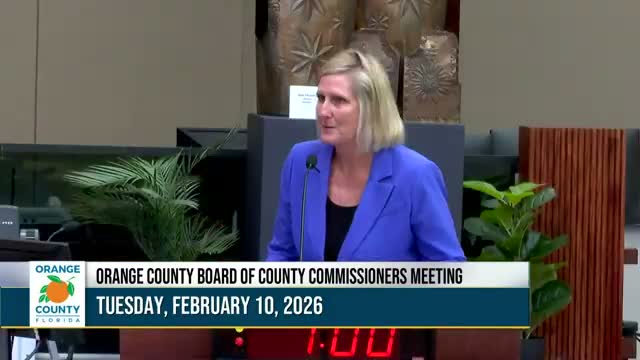
Summary
After months of audit work and negotiations, the County Commission approved a third amendment clarifying how Visit Orlando classifies tourist development tax (TDT) revenues, requires overhead allocation and shortens fund‑carryforward rules. Comptroller Diamond praised reclassification of roughly $10.4 million to publicly disclosed TDT accounts.
The Orange County Board of County Commissioners on Feb. 10 approved a third amendment to the county’s 2019 tourist promotion agreement with Visit Orlando, a measure county officials said clarifies how Visit Orlando must classify and report tourist development tax (TDT) revenues and strengthens accountability after a comptroller audit.
The amendment, adopted on a 5‑to‑2 roll‑call vote, requires Visit Orlando to reclassify revenues that industry and county staff determined were previously sitting in private accounts, adopt a standardized overhead cost‑allocation method, provide clearer work plans and monthly TDT disbursements, and offers a 45‑day cure period before broader remedies. Comptroller Phil Diamond said the reclassifications move millions into publicly disclosed accounts and improve transparency: "By reclassifying funds from their private accounts to public accounts, taxpayers get transparency, they get accountability," he said.
Why it matters: the audit identified categories of revenue and expenses that auditors concluded should be treated as TDT‑funded. County staff and the comptroller said the work addressed the key audit recommendations, including retrospective reviews back to 2019. County officials said the amendment preserves TDT restrictions while adding clearer processes for ROI calculations, pre‑event approvals and monthly reporting.
What the amendment does: staff said it requires Visit Orlando to allocate overhead expenses proportionally between TDT and non‑TDT activities, return unspent work‑plan funds to the organization’s public TDT account rather than rolling them into the next year, and to obtain board approval before lobbying on legislative matters. The amendment also codified procedures for reclassifying revenues where county review found earlier ambiguity.
Visit Orlando’s response: Visit Orlando officials said they approached the audit with a spirit of collaboration, implemented policies to strengthen internal controls, and welcomed the comptroller’s partnership. A Visit Orlando representative told the board the organization worked with county staff and the comptroller to reach the revisions.
Board debate and next steps: several commissioners pressed county staff about the timing of documents and the late distribution of revised drafts, arguing for more lead time to review complex accounting language. Others urged moving forward to avoid harming the tourism economy. Commissioners directed staff to continue independent ROI analysis, add a dedicated county oversight resource for TDT funds, and return with any non‑substantive corrections to the amendment.
The amendment is effective immediately; county staff said they will continue oversight, perform a county‑sponsored ROI analysis and pursue implementation steps recommended by the comptroller.