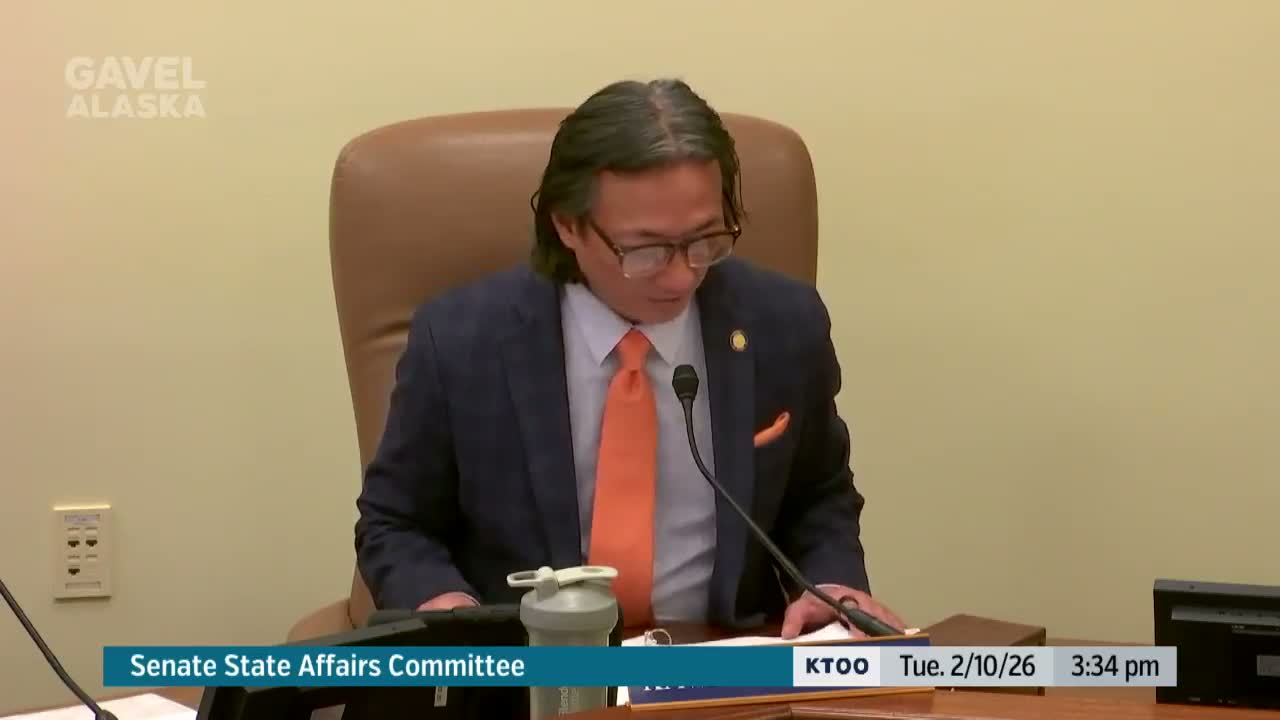
Senate committee hears debate over SB 126, pauses bill authorizing out-of-state placements
Loading...
Summary
The Senate State Affairs Committee held a second hearing on SB 126, which would authorize DOC to study consolidations and allow out-of-state placement for prisoners with seven or more years remaining; witnesses from the ACLU and a formerly incarcerated Alaskan warned of harms, and the committee set the bill aside for amendments.
Sen. Rob Young introduced Senate Bill 126 on Feb. 10, asking the Senate State Affairs Committee to allow the Department of Corrections to investigate consolidating facilities and, if cost-effective, place prisoners with seven or more years left on their sentences in out-of-state facilities.
The bill would add subsections to AS 33.30.061 granting the DOC commissioner authority to examine consolidation and out-of-state placement, require the state to estimate annual cost savings from such actions, and permit the Legislature to appropriate an amount equal to the estimated savings for education purposes.
The committee heard public testimony from Mike Garvey, policy director for the American Civil Liberties Union of Alaska, who urged caution about embedding out-of-state placement authority in statute. "Sending people to prisons outside jeopardizes constitutional rights," Garvey said, citing concerns about due process, access to counsel and medical care, and the difficulty for families and oversight bodies to maintain contact and visibility. He recommended better use of existing parole routes, including geriatric and medical parole, as alternatives to reducing correctional costs.
Adam Barger, who said he was incarcerated in Alaska from 1994 to 2019 and later moved under an interstate compact, also opposed statutory authorization for out-of-state transfers. Barger told the committee that the first mass transfers in the 1990s correlated with the importation of gang culture, worsened behavioral and medical outcomes, and left families with prohibitive travel and communication costs.
Sponsors and committee members discussed the bill's mechanics and intent. Ryan McKee, staff to the sponsor, explained that when the committee pulled the data there were 792 inmates with seven or more years remaining, a figure he said could change and that the Legislature would continue shaping the bill. McKee said one design consideration was ensuring Alaskans housed out of state would be housed apart from nonresidents of Alaska.
Committee members also pressed the sponsor about which specific facilities might be consolidated or closed; Sen. Rob Young said such facility-selection decisions should be left to DOC leadership and the executive branch rather than individual legislators. Chair Kawasaki noted the long history of facility consolidation debates in Alaska and questioned whether prior promises about cost savings and recidivism had been realized.
The committee did not vote on SB 126. Instead it set the bill aside to establish an amendment deadline; the chair asked that amendments be submitted by Wednesday and scheduled further consideration (a hearing was planned for Feb. 12). The committee also requested additional information from DOC about costs, capacity and related topics before further action.
The hearing record shows two main lines of contention: fiscal arguments for consolidation and potential cost savings versus constitutional, rehabilitative and family-preservation concerns raised by civil liberties and formerly incarcerated witnesses. No formal action beyond setting the bill aside and requesting amendments was taken at the Feb. 10 meeting.