Get AI Briefings, Transcripts & Alerts on Local & National Government Meetings — Forever.
Guidehouse tells Alaska senators Medicaid rates are uneven; recommends new methodology, cost reporting and selective increases
Loading...
Summary
A Guidehouse study for the Alaska Department of Health found reimbursement misalignment across Medicaid services, high indirect costs (about $0.40 per dollar), and recommended a building‑block rate methodology, hold‑harmless protections, geographic differentials and annual cost reporting; DOT/DOH and legislators discussed timelines and budget implications.
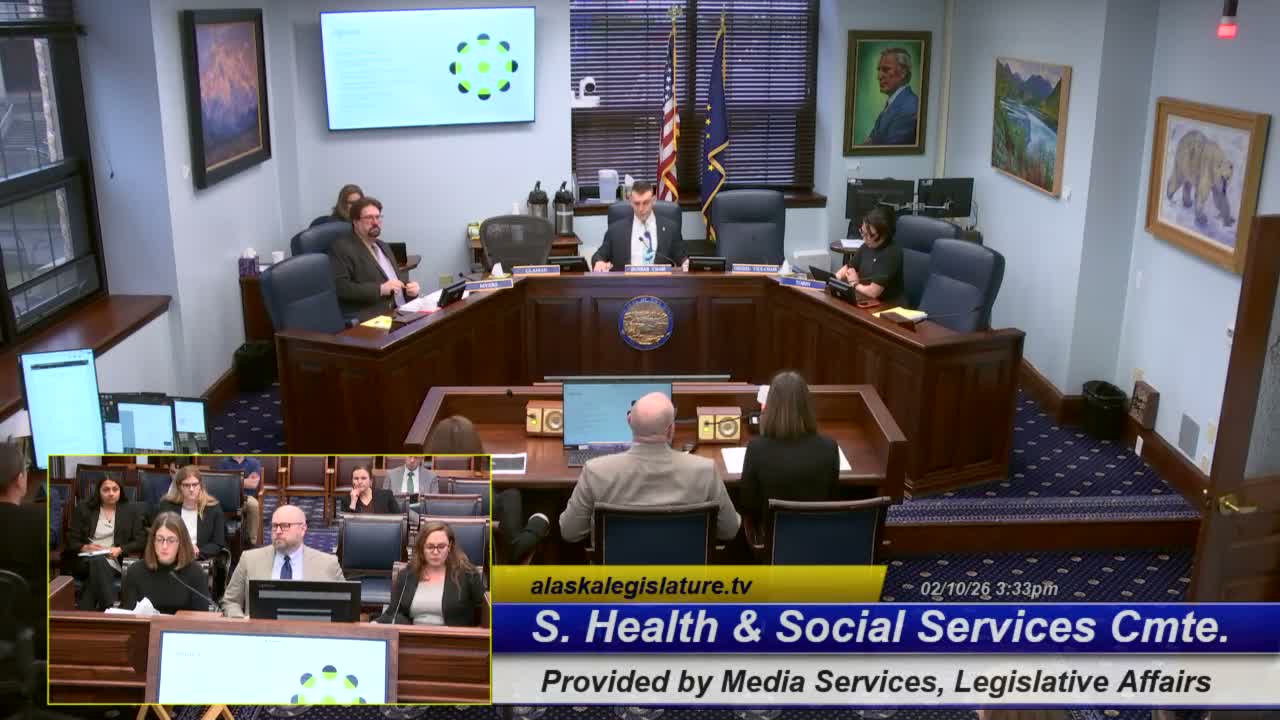
Juneau — A consultant hired by the Alaska Department of Health told the Senate Health and Social Services Committee on Feb. 10 that state Medicaid rates for behavioral health, long‑term services and supports, federally qualified health centers and medical transportation are unevenly matched to providers' costs and that a new methodology and ongoing cost reporting are needed.
"We asked very specific cost questions to individual providers within the state of Alaska," said Claire Payne, behavioral health lead at Guidehouse, noting the firm surveyed providers, conducted on‑site visits including in rural hubs and a village (Port Heiden) and compiled Alaska‑specific benchmarks. Guidehouse found some services under‑reimbursed (Payne cited autism services that may require roughly a 100 percent increase) while others are adequately or over‑reimbursed.
The study also identified unusually high indirect costs. "For every dollar that gets paid into the system, 40¢ on every dollar goes to this overhead bucket," Payne said, adding that other states typically see 20–30¢ in overhead. Guidehouse recommended a transition to a building‑block rate methodology that makes every cost component transparent, paired with hold‑harmless protections for providers where recalibration would reduce rates.
Deputy Commissioner Emily Ricci (Department of Health) said the reports are intended to give policymakers options. "There's no expectation from the department that all of these recommendations be implemented," Ricci said, adding that the department asked Guidehouse for fiscal estimates to show the order of magnitude for the recommendations.
On specific program areas, Guidehouse recommended: rate rebalancing in behavioral health with geographic adjustments and crisis‑service updates; continued cost collection and possible 30–35 percent increases for some long‑term personal care services; a one‑time catch‑up and clearer policy pathway for some FQHCs still on the PPS payment method; and a substantial raise for ambulance reimbursement to about 125 percent of Medicare with seasonal lodging rates and brokerage models for transportation.
Senators pressed on feasibility and federal oversight. "Our methodology is fully accepted by CMS," Guidehouse's Coy Jones said, describing the building‑block approach as consistent with federal rules, but he cautioned that implementation depends on available state budget and prioritization by legislators and appropriators.
Ricci said the department is already moving on behavioral health. "There is $10,000,000 temporary increment that was included in the FY26 budget in the supplemental; that proposed language extends that into FY27," she said, and added that rulemaking to rebalance behavioral health rates under a hold‑harmless approach is underway.
Guidehouse and DOH recommended setting up an annual cost‑reporting mechanism so rates could be updated routinely rather than through episodic rebasing, but both also acknowledged the administrative burden and the need to design a system that is not overly onerous for smaller providers.
The transportation report (covering both emergency and non‑emergency medical transportation) was described as in the late stages and likely to be finalized in a few weeks. Committee members and Guidehouse discussed options to boost federal matching in rural originations and to reduce barriers for tribal and rural providers.
The committee did not take formal action on the Guidehouse recommendations during the hearing. The presentation materials and detailed reports are being finalized and will be available to the legislature and stakeholders; DOH and Guidehouse framed the findings as a menu of options that the state can pursue subject to budgeting and further policy decisions.
Next steps: DOH said it will continue rulemaking and stakeholder engagement on behavioral health rate rebalancing and work on cost‑reporting approaches; the full Guidehouse reports and fiscal estimates will be released to the committee and the public when finalized.