
Senior and Disability Services details waivers, assisted-living growth and adult-protective services limits
Get AI-powered insights, summaries, and transcripts
Subscribe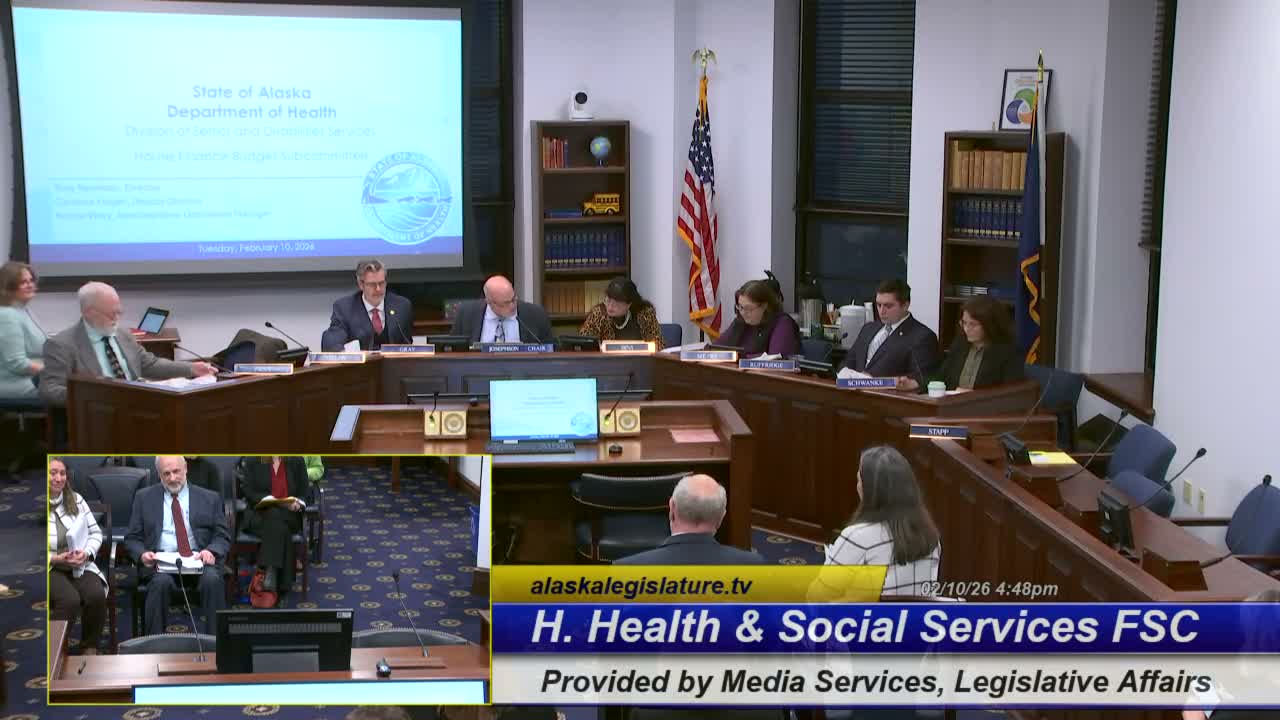
Summary
The Department of Health’s Division of Senior and Disability Services told the House Finance Health Subcommittee it supports grant programs for about 22,000 Alaskans, is renewing four of five Medicaid waivers, reported a 7% increase in assisted-living home participation, and said adult protective services completes investigations for a subset of reports due to triage and staffing constraints.
Juneau — The Department of Health’s Division of Senior and Disability Services delivered its FY2027 operating-budget presentation to the House Finance Health Subcommittee on Feb. 10, outlining grant programs, Medicaid waiver renewals, assisted-living trends and adult-protective-services capacity.
Director Tony Newman summarized the division’s mission: to "promote the health, well-being, and safety of individuals with disabilities, seniors, and vulnerable adults" and explained that Medicaid service spending is included in the Medicaid services component rather than the division’s operating-budget slide.
Grants and senior services: Newman said the division’s grant services reach about 22,000 Alaskans through roughly two dozen grant programs that support meals-on-wheels, senior center lunches and other local services. He noted the legislature provided $2.5 million in FY2026 to stabilize senior centers and $100,000 for a deaf navigator program operated by Hope Community Resources of Anchorage.
Assisted living and waivers: The division reported 293 assisted-living homes participating in the general-relief assisted-living-home program, up from 274 the prior year (about a 7% increase). Newman emphasized that the home-and-community-based Medicaid waivers — four of five currently in five-year renewal — let Alaskans remain at home and, the division estimates, avoid over $1 billion in institutional-care spending and save the state roughly $700 million compared with an institutional-only approach.
Adult Protective Services (APS): Newman said the division’s centralized reporting received 7,895 reports and completed 1,261 investigations in the prior period (about 16% resulting in completed investigations). He explained many reports are triaged to information-and-referral rather than assigned for formal investigation. APS has a staffing presence in Anchorage and Fairbanks and reported a vacancy in Juneau; investigators may travel to conduct outsized investigations when necessary.
interRAI assessment project: Deputy Director Caroline Hogan described a multi-year interRAI assessment implementation funded by three years of legislative appropriations beginning in FY2024. The state secured a federal match (reported as 90% for planning and implementation phases), the contract with a software vendor was signed in December 2025, and Phase 1 assessments are targeted for launch by the end of calendar year 2026.
Next steps: Newman said the division will continue long-term initiatives including quality-assurance improvements and multi-disciplinary community approaches for vulnerable adults; lawmakers requested further budget detail on Medicaid-match components and the state’s share of aggregated Medicaid spending.
Attribution: Quotes and figures in this article are drawn from testimony by Tony Newman, Nicole Weary, and Caroline Hogan during the House Finance Health Subcommittee meeting on Feb. 10, 2026.