Alaska’s Division of Public Assistance seeks to make eligibility systems permanent while stabilizing childcare and SNAP services
Loading...
Summary
Department of Health officials told the House Finance Health Subcommittee that the Division of Public Assistance’s FY2027 governor’s budget totals $340.4 million and includes investments to stabilize childcare, extend SNAP modernization activities and shift eligibility systems from capital to operating costs while hiring eligibility technicians to reduce error rates and timeliness backlogs.
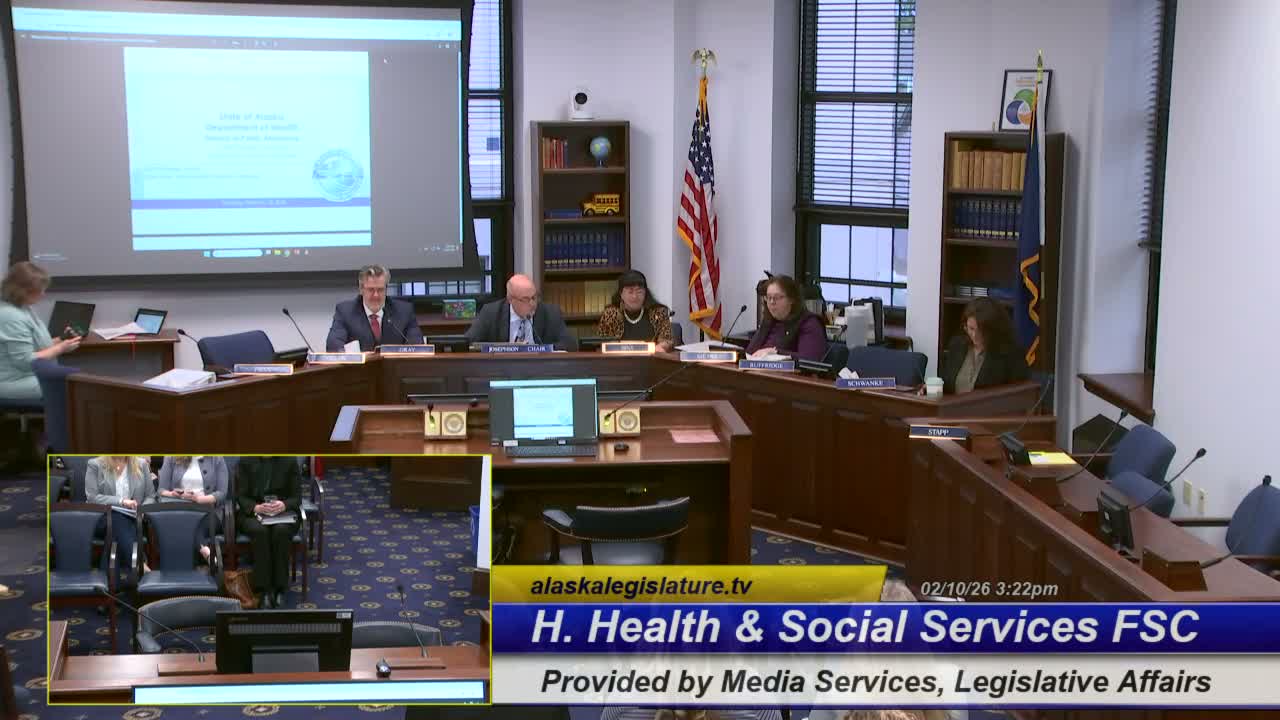
Juneau — The Department of Health’s Division of Public Assistance told the House Finance Health Subcommittee on Feb. 10 that the governor’s FY2027 budget for the division totals $340,400,000 and includes steps to sustain recent investments in childcare, extend SNAP modernization work and move eligibility systems from capital projects into the operating base.
Director Deb Ethridge said the division served "more than 426,000 Alaskans," roughly 58% of the state’s population in fiscal year 2025, and described work to modernize eligibility, reduce error rates and improve timeliness. The governor’s FY2027 request includes 502 full-time positions and, Ethridge and administrative operations manager Sierra Meek said, reflects the net effect of one-time funds expiring and continuing base investments.
Why it matters: Committee members pressed agency officials about several interlocking risks — a persistent SNAP timeliness backlog (Ethridge reported about 3,000 untimely SNAP cases and an average processing time of 44 days), federal penalty exposure under HR1 tied to error rates, and the operational cost shift required as eligibility systems move from capital to the operating budget.
Childcare and SB95: Meek and Leah Van Kirk, a healthcare policy adviser in the commissioner’s office, told the committee that a $5,900,000 appropriation for the childcare grant program was added to the base rather than as a one-year increment. Van Kirk said the department is redesigning the childcare grant structure to implement Governor’s Task Force recommendations and SB95, which expands eligibility and caps family co-payments. Van Kirk said the base addition allows the department "to implement sustainable programs that support childcare providers."
SNAP modernization and disaster funds: The division is continuing a SNAP "new investment" program approved by federal partners in October 2025 that funds tools for eligibility technicians, client-facing portal improvements and quality assurance. Committee members raised whether SNAP benefits were temporarily replaced by state funds during the federal government shutdown; Ethridge said SNAP benefits are federally funded but confirmed the state used $5,000,000 in state disaster-relief funds to bridge emergency needs and distributed those funds through food banks during the shutdown. Ethridge said she would follow up with more precise appropriation details.
Eligibility systems and ARIES: Ethridge and Assistant Commissioner Pam Halloran described ARIES as the foundation for modernization. As development work completes, costs that were previously capital expenditures are shifting into the operating budget; Meek explained that the FY2027 figures correct for that transition. The agency told lawmakers an eligibility-systems line reflects rising operational costs as systems move from development into state operations and that some previously capitalized expenditures are now added to base operating costs.
Virtual contact center and contractor staffing: The virtual contact center handles roughly 20,000–24,000 calls per month. Halloran said the department temporarily maintained the center by leveraging eligible Medicaid funding identified through a time-study; contracted staff perform first-contact screening and some data entry, while the division plans to train permanent eligibility technicians to phase out contract dependence.
Workforce and penalties: Ethridge said the division’s eligibility-technician vacancy rate peaked near 34% in 2025 and has fallen to about 23%. Lawmakers pressed whether that is sufficient to address past federal fines; Representative Mina referenced prior penalties, and committee materials cited fines of $11.9 million (FY2024) and $4.6 million (FY2025). Ethridge said the division has seen "tremendous improvement" and described an investment plan and quality controls aimed at reducing error rates and avoiding further penalties.
Next steps: The division said it will provide follow-up data requested by members, including counts of licensed childcare slots and the number of children served, documentation of fund sources used during the federal shutdown, and more granular staffing and milestone timelines for the ARIES modernization. Chair Josephson closed the division’s testimony and moved the agenda to the Division of Senior and Disability Services.
Attribution: Quotes and figures in this article are drawn from testimony by Director Deb Ethridge, Administrative Operations Manager Sierra Meek, Leah Van Kirk (healthcare policy adviser), and Assistant Commissioner Pam Halloran during the House Finance Health Subcommittee meeting on Feb. 10, 2026.