
House bill would create net‑metering program and reimbursement fund for rail‑belt utilities
Get AI-powered insights, summaries, and transcripts
Subscribe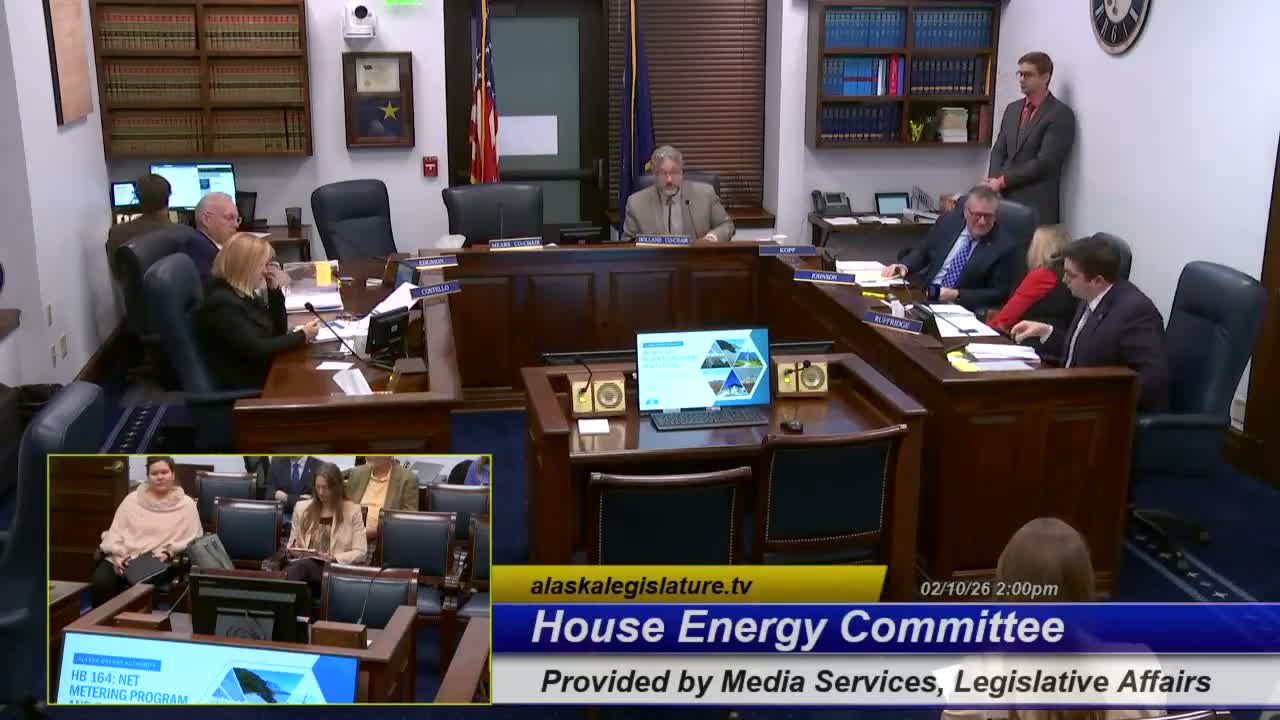
Summary
House Bill 164 would statutorily establish a net‑metering program for rail‑belt utilities, allow utilities to adopt seasonal or time‑of‑use compensation and create an Alaska Energy Authority‑administered reimbursement fund for revenue impacts; the committee sought details on fund capitalization and rate impacts.
House Bill 164, presented Feb. 10 to the House Special Committee on Energy, would create a statutory net‑metering program for rail‑belt utilities and a Net Metering Reimbursement Fund administered by the Alaska Energy Authority (AEA).
Connor Erickson, identified in the record as director of planning with the Alaska Energy Authority, said the bill places the net‑metering framework into statute for rail‑belt utilities and allows utilities to provide compensation for customer‑generated energy either at a rate equivalent to the small facility power purchase rate (the current avoided cost rate) or at alternative seasonal or time‑of‑use rates approved by the Regulatory Commission of Alaska (RCA).
Erickson described the program’s mechanics: consumer generators could receive credits for excess generation that would be accounted annually so credits produced in high‑production months could offset usage in low‑production months. The bill would also authorize a reimbursement fund for utilities to request payment from AEA for revenue impacts that are defined and approved through RCA regulation. The bill text (as explained in the sectional) sets an effective date of July 1, 2025.
RCA staff member Julie Vogler told the committee that avoided cost (small facility power purchase) and time‑of‑use structures are both in the commission’s toolbox and that tariff sheets and revenue‑requirement proceedings would govern rate calculations and approval.
Committee members repeatedly asked how large the reimbursement need might be and whether the fund’s capitalization (legislative appropriations, gifts, federal dollars and interest) would be sufficient. Erickson and industry witnesses said the size of potential revenue losses is uncertain and depends on the quantity of customer generation and the specific utility’s tariff structure. Erickson said decisions on compensating rates would remain subject to RCA approval.
Industry witness Ben May (Alaska Solar) testified that better alignment of compensation with retail or time‑of‑use rates would improve consumer economics and uptake. May said a 25‑kilowatt system in Alaska typically produces about 25,000 kilowatt‑hours annually and that improving compensation can reduce residential payback to about a 10‑year range at higher retail rates. He also argued the current cross‑subsidization concern is likely small but should be quantified through the bill’s mechanisms.
Committee members requested follow‑up analysis on how the program would function if the reimbursement fund is not capitalized, how rates would be adjusted to protect system reliability, and additional modeling on distributional impacts. AEA and RCA staff were asked to provide calculations and further detail at a future meeting. No vote was taken; the bill was set aside for additional information.