Alaska Mental Health Trust outlines FY27 budget, raises payout to 4.5% to boost grants
Loading...
Summary
The Alaska Mental Health Trust Authority presented its FY27 budget to the House Finance Committee, explaining a trustee-approved increase in the annual draw from 4.25% to 4.5% (adding about $1.9 million) and emphasizing grantmaking, land-office revenue and a strategic plan focused on prevention, crisis response and data-driven investments.
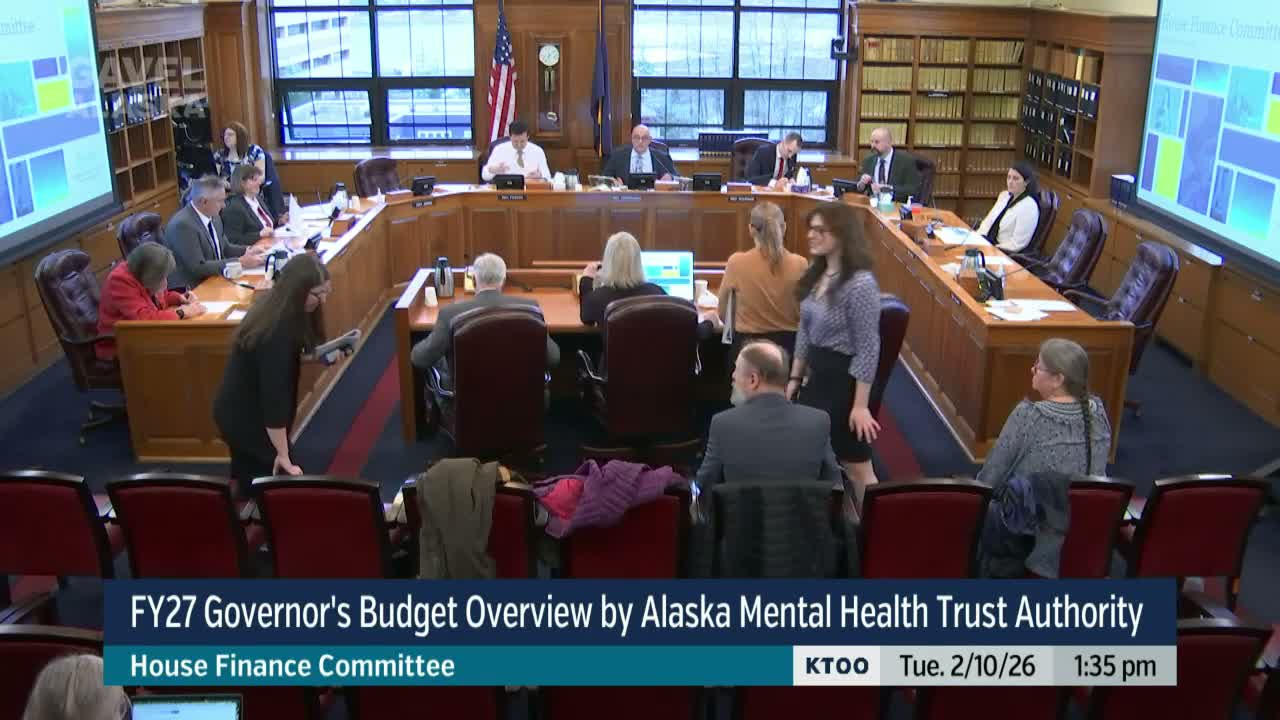
The Alaska Mental Health Trust Authority told the House Finance Committee on Feb. 10 that trustees are recommending a modest increase in the annual withdrawal from trust investments to fund beneficiary services now while preserving assets for the future.
"Trustees worked with Callan...and determined that it was prudent to change it from 4.25%...to 4.5%," said Mary Wilson, the trust's chief executive officer, explaining that the change is reflected for the first time in the FY27 budget and "resulted in an additional $1,900,000 available funds." The presentation was given by Wilson alongside board chair Brent Fisher and COO Katie Baldwin Johnson.
Why it matters: The Trust is a self-funded state corporation charged with improving the lives of Alaskans who experience mental illness or developmental disability; its spending decisions affect grant programs run by state agencies, nonprofits, tribal entities and local governments across Alaska. The trustees said the higher draw rate is meant to balance current beneficiary needs with the trust's perpetual mandate.
Key facts presented
- Assets and corpus: Wilson said the trust's corpus (the portion managed by the Alaska Permanent Fund Corporation) was reported at about $559 million for FY25. The Trust also reported reserves targeted at 400% of annual spend and $125 million in unrealized appreciation that is not available for spending until realized.
- Funding sources for FY27: Wilson described four components of annual spend: (1) a withdrawal from invested assets (the 4-year average payout, now 4.5%), (2) TLO (Trust Land Office) spendable income (about $4.3 million, 2-year average), (3) carried-forward prior-year funds (about $4.5 million), and (4) interest earnings (about $2.4 million).
- Grants and MTAR: Trustee-recommended spending emphasizes grantmaking and beneficiary initiatives. The Trust said MTAR grants to state agencies total approximately $11.4 million for FY27, with more than 63 MTAR increments transmitted for inclusion in department budgets. Since inception, the Trust has granted more than $260 million to state agencies and roughly $24 million in total grant investments were awarded in FY25 across 149 grants.
- Trust Land Office and revenue: The Trust Land Office manages roughly 1,000,000 acres and multiple asset classes (forestry, minerals, energy, commercial ground leases and program-related real estate). The Trust anticipates more than $12 million in revenue from trust land assets for the fiscal year. The board has been divesting commercial real estate outside Alaska (four of six properties already sold; two remain in Texas, to be marketed when timing is right).
Committee questions and responses
- On the draw change: Representative Bynum and others pressed for clarity on why the Trust moved to 4.5%. Wilson said multiple scenario analyses showed 4.5% would better serve current beneficiaries without imperiling long-term sustainability and noted the Trust uses a 4-year blend to smooth market volatility.
- On land sales vs. recurring revenue: TLO Executive Director Jesse Warner explained land sales are usually one-time payments that become part of the corpus while leases and contract interest provide recurring spendable income; land-sale contracts can include interest paid over terms up to 20 years.
- On program effectiveness and data: Committee members sought examples of measurable outcomes and whether grants without measurable results are discontinued. Wilson and Johnson said every grant includes outcome measures to the extent feasible and that the Trust is working to improve evaluation and reporting; Johnson said the Trust can share more detailed program-level information in writing.
- On cultural responsiveness and crisis services: Johnson described efforts to ensure call-center and mobile crisis responses are culturally responsive, noting tribal health systems are developing complementary tribal crisis lines and the Trust supports local partnerships and training.
Other details
- The Trust said its FY25 activities included training more than 5,000 beneficiary-serving individuals in roughly 100 communities and supporting 5,000 families with early intervention and related services; the Trust also reported about 9,500 mobile team responses.
- The Trust supports technical assistance and grant-writing contracts (a small contract around $200,000 annually) that staff said have helped bring approximately $45 million in additional funding into Alaska over the last three years.
On the record
Board chair Brent Fisher said the board had "realigned our charters and bylaws" and cited the crisis program initiative's expansion to rural communities as a priority. Wilson closed the Trust portion of the hearing by noting the Trust remains an independent, self-funded entity that works in close partnership with state agencies and community partners.
Next steps
The committee took the Trust presentation under consideration and moved to public testimony on supplemental budget items. Committee members requested additional written follow-up on some program and outcome details.
Sources: Presentation and Q&A with Mary Wilson, Brent Fisher and Katie Baldwin Johnson before the Alaska House Finance Committee on Feb. 10, 2026.