Senate committee hears Whittier land‑transfer bill; railroad and city explain deal, committee sets bill aside
Loading...
Summary
At a Feb. 10 first hearing, SB191 was presented to authorize sale of three downtown Whittier parcels from the Alaska Railroad to the City of Whittier. Alaska Railroad and the city described a conditional letter of intent and board approval for parcels 1–3; the committee set the bill aside for further consideration.
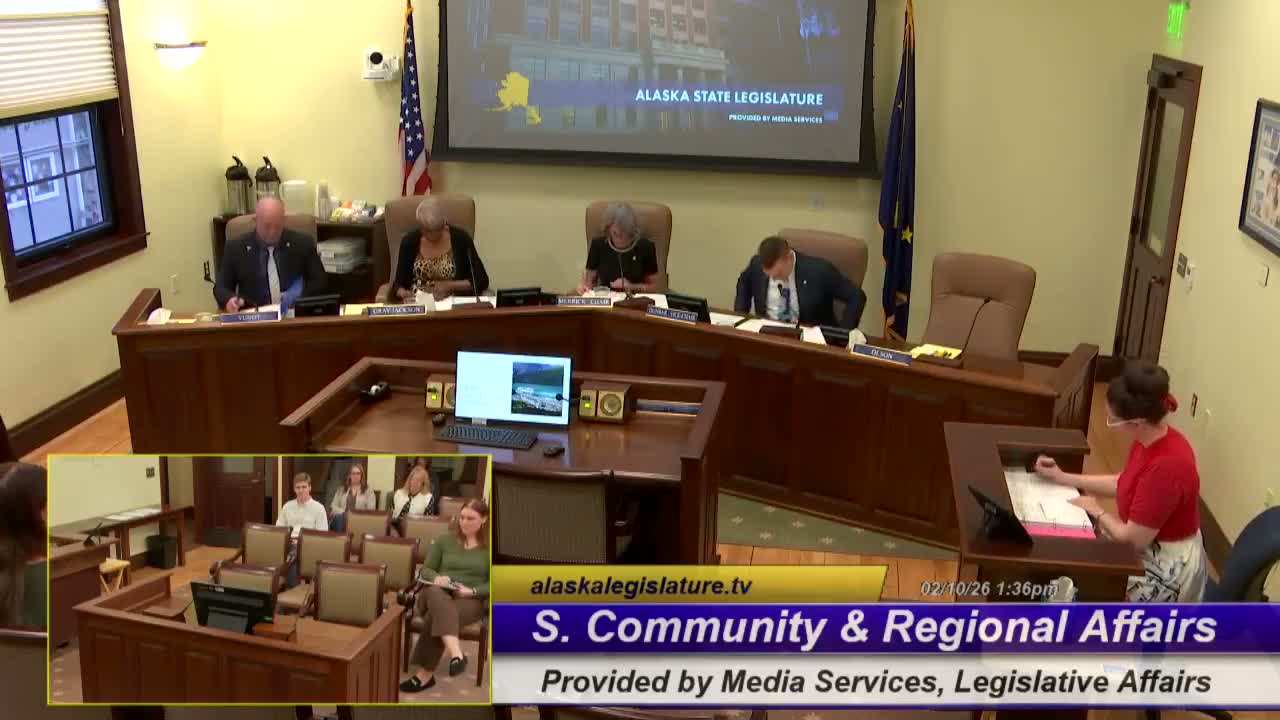
The Senate Community and Regional Affairs Committee held a first hearing on Senate Bill 191 on Feb. 10, 2026, which would authorize the Alaska Railroad Corporation to sell identified parcels of land to the City of Whittier.
Paige Brown, staff to Senator Giesel, described Whittier as a small coastal city with about 272 residents that nonetheless sees substantial seasonal visitation. She said the Alaska Railroad Corporation currently owns about 85% of Whittier's developable downtown and waterfront land, which the city says limits housing and harbor development. "Whittier has a small population of 272 people that sees thousands of tourists in the summer," Brown told the committee.
Megan Clemens, external affairs director for the Alaska Railroad Corporation, said the railroad supports the bill and noted that selling railroad land requires both legislative authorization and railroad board approval. Clemens said the railroad offered to sell three downtown parcels at fair market value, received a conditional letter of intent from the city in late January, and that the Alaska Railroad Board of Directors recently passed a resolution approving sale of areas of interest 1–3. "Completing the sale of parcels 1, 2, and 3 would in no way preclude revisiting parcels 4 and 5 for a potential sale to the City of Whittier in the future," Clemens said.
Jackie Wild, city manager for Whittier, outlined the city's history under a 1998 master lease of railroad lands in which the city pays 40% of gross revenue for those lands. She described a two‑phase transaction: purchasing AOI‑1, AOI‑2 and AOI‑3 (harbor/core downtown) first, with AOI‑4 and AOI‑5 a possible later phase. Wild said AOI‑2 could accommodate additional housing and noted that Whittier recently added a second cruise ship terminal; she gave a seasonal visitor estimate of about 700,000 annually, of which roughly 200,000 are cruise‑related.
A committee questioner asked whether the city would be buying the land rather than receiving a simple transfer; Brown confirmed the city would pay for the property and the questioner said the amount recalled was "4 point something million," attributing the figure to memory rather than a formal filing.
No final action was taken at the first hearing; Chair Merrick said the committee would "set this bill aside for further consideration." Additional details — including final sale price and the city's funding plan — were not resolved at the hearing and were described by witnesses as matters being finalized between the railroad and the city.
Why it matters: The transfer could free developable waterfront and harbor land for local housing, harbor services and economic development in a community that is geographically constrained by historic railroad ownership of downtown parcels.
Next steps: The committee set SB191 aside for further consideration; the record indicates interested parties are negotiating final terms and that the legislature's authorization would be required before a sale could close.