DOT presses FTA on rural ferry grant as AMHS faces budget gap and possible vessel disposal
Loading...
Summary
DOT officials told the House Finance subcommittee they will meet FTA leadership about an outstanding FY26 rural ferry competitive grant and said the department is exploring cost reductions for the Alaska Marine Highway System, including potential sale of the Matanuska, noting hoteling costs of about $10 million annually and estimated hoteling-in-town costs of about $3 million.
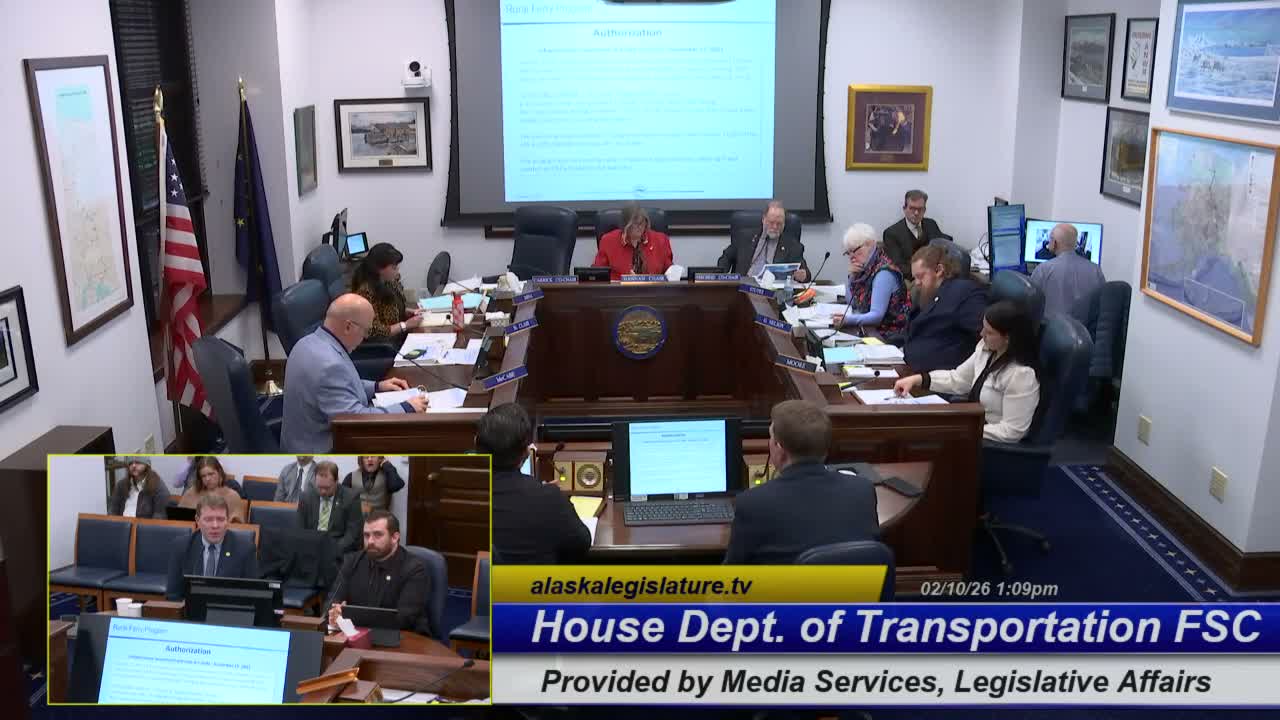
Department of Transportation and Public Facilities leaders told the House Finance DOT&PF Subcommittee on Feb. 10 they are pressing federal officials for an outstanding FY26 award under the Infrastructure Investment and Jobs Act (IIJA) Ferry Services for Rural Communities program and preparing contingency plans for the Alaska Marine Highway System (AMHS) if competitive grant funding does not materialize.
Commissioner Ryan Anderson said DOT is scheduling a Washington, D.C. meeting with the Federal Transit Administration administrator and deputy administrator in two weeks to discuss the FY26 award. He described the IIJA program (citing §71103) as a $1 billion, five-year appropriation that provides roughly $200 million annually for competitive grants, and said Alaska’s geography — routes that serve two rural communities separated by at least 50 sailing miles — gives the state a strong position in the discretionary program.
Anderson and Dom Penon outlined program dependence: Penon said DOT has used the grant for capital projects and operating supports and warned of a $78,000,000 federal revenue gap the department is working to close. Anderson said DOT is evaluating near-term cost reductions within AMHS to extend cash on hand and identified one major option: disposing of the vessel Matanuska, which DOT has been using as a hotel ship. He said AMHS’ preliminary estimate of Matanuska hoteling costs is "in the range of $10,000,000 a year." He also said DOT estimated it would cost about $3,000,000 annually to house affected personnel in hotels in Ketchikan, but that hotel space is scarce in summer.
Members queried whether recent or planned projects (for example, Cascade Point) could alter the 50-sailing-mile eligibility for IIJA grants; DOT said it would need to evaluate any changes and that the grant’s eligibility is based on the ferry entity serving two or more rural communities at least 50 sailing miles apart. Anderson said local route changes would not automatically change the fact that the system qualifies for the program; the grant is awarded to the ferry entity, not to a single route.
On ship disposal timing, Anderson said the department must complete a public interest finding, appraisal and public solicitation (RFI) and noted Director Tornga was preparing a best-interest finding to enable appraisal and next steps. When asked about proceeds from prior vessel sales, Anderson gave figures that appear inconsistent in the transcript (a reported figure of "between a $102,100,000 dollars" for the Malaspina sale), which the department did not further clarify on the record.
Penon described three years of operating funds from the IIJA program and use of capital funds for ports, terminals and the Tustamina replacement vessel. He said DOT will advocate for expedited grant processing if awarded and reiterated that a portion of DOT’s Unrestricted General Fund (UGF) counts as match for the operating grant; marine highway revenue funds are state-designated general funds.
The subcommittee did not vote. Members pressed DOT for continued updates and asked that the department return with specifics after the Washington meeting and any finalized appraisal or solicitation steps related to the Matanuska.