DOT proposes two statewide directors and 24-position cut in FY27 reorganization plan
Loading...
Summary
The Alaska Department of Transportation and Public Facilities told a House Finance subcommittee it will convert three regional director roles into two statewide functional directors and delete 24 positions (saving $3.74 million) as part of an FY2027 reorganization intended to preserve frontline services while restoring a prior 12.2% UGF reduction in its budget request.
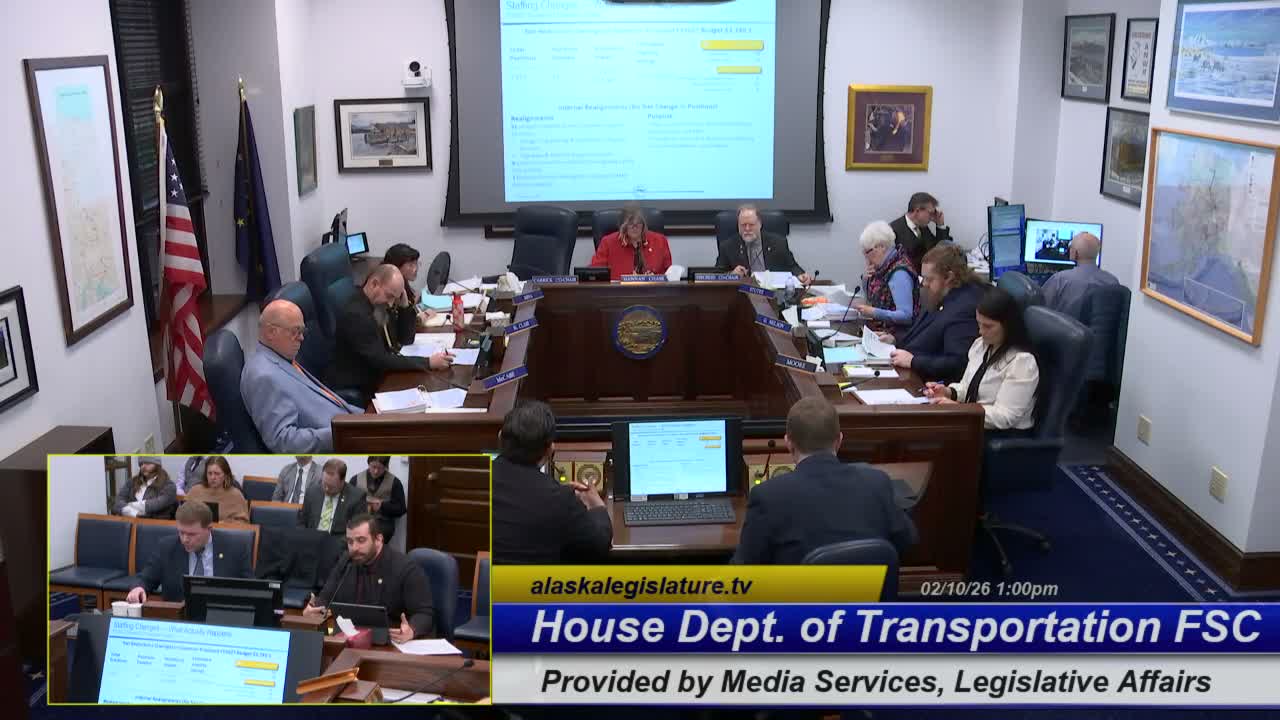
The Alaska Department of Transportation and Public Facilities on Feb. 10 told the House Finance DOT&PF Subcommittee it plans to keep three geographic regions but add two statewide functional directors — one for infrastructure development and one for maintenance and operations — as part of a reorganization that officials say will standardize service while protecting frontline staff.
Commissioner Ryan Anderson said the department’s statutory mandate under AS 19.05.125 has not changed, but that the operating environment is evolving and requires “a more disciplined use of our limited financial and workforce resources.” He described strategic assets such as the Alaska International Airport System, the Alaska Marine Highway System (AMHS), the statewide equipment fleet and commercial vehicle compliance as continuing to operate as distinct budget components while cross-functional teams (finance, data modernization, procurement, communications, civil rights) are strengthened.
Dom Penon, management administration director, told the committee the FY27 budget proposal would delete 24 positions to save $3,740,000. He said the deletions include six partially exempt appointed positions, 14 General Government Unit bargaining positions and four supervisory positions; at the time of the proposal 10 of the affected positions were filled and six have since been reassigned or identified new positions. Penon said those supervisory deletions affect “less than 1% of the entire department,” which he said has approximately 3,400 positions.
The department said the three regional director PX range 27 positions are being converted into two statewide director roles through position management rather than increasing frontline work. Anderson emphasized the intent is not to cut frontline maintenance jobs — “we aren't making any changes to our snow plowing, our pothole filling” — but to redistribute management responsibilities to gain consistency across regions and reduce duplicate leadership overhead.
On fiscal context, Penon said the FY26 legislative process produced a more-than-$5 million reduction to maintenance and operations — a 12.2% UGF cut — which DOT managed through position management and vacancies. The FY27 request asks for restoration of those funds while also proposing program changes intended to offset other M&O needs.
Penon also described returning payroll and accounting services from the Department of Administration to DOT, saying the positions moved to DOA about a decade ago and DOT expects to receive approximately the same number of positions back “without a budget increase because we continue to pay for them.” The department noted prior payroll problems in AMHS were improved after a similar transition for that system.
Anderson outlined an implementation timeline labeled “early transition,” saying position transfers will occur as vacancies arise, with formal alignment after budget approval and work sessions to identify pitfalls. He acknowledged a change in administration could alter plans but said the department believes the reorganization will deliver more consistent service statewide.
The subcommittee did not take formal action. Members pressed DOT for details about classification of the deleted positions, staffing protections and how the new directors would be selected and supervised; DOT provided the classifications and said recruitment would target individuals with subject-matter expertise in either maintenance/operations or infrastructure development.