
House Finance hears ADA budget update as members press board dividend size and review pipeline projects
Get AI-powered insights, summaries, and transcripts
Subscribe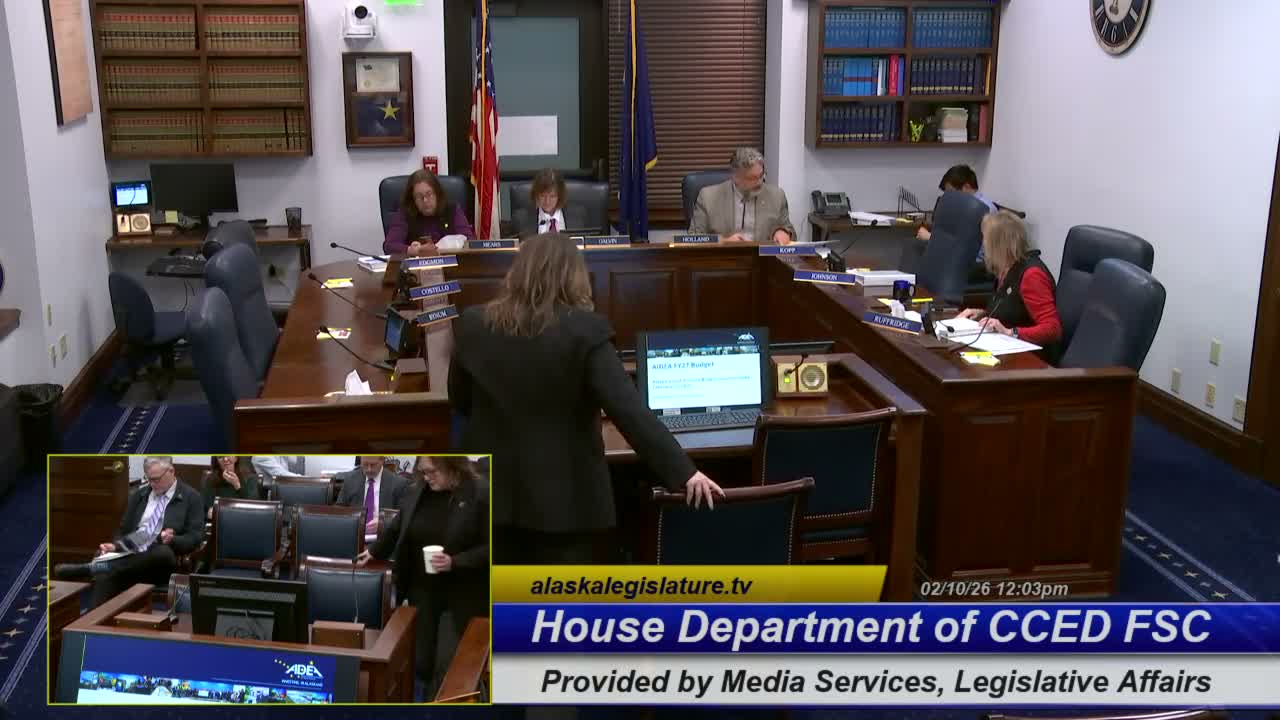
Summary
Alaska Industrial Development and Export Authority (ADA) reported FY2025 statutory net income of $67.4 million and a board-declared $17 million dividend. Legislators pressed ADA leadership on why the dividend was set below the statutory maximum and probed major projects including ANWR leases, Ambler access and the Ketchikan shipyard.
The House Finance DCCED subcommittee heard a budget presentation from the Alaska Industrial Development and Export Authority on Feb. 10, where ADA leaders outlined recent financial performance, a modest dividend to the state and a pipeline of large projects that they say justify retaining cash.
ADA Executive Director Randy Ruaro told the committee ADA posted statutory net income of $67.4 million for FY2025 on roughly $100 million in gross revenues and that the board declared a $17 million dividend to the state. Ruaro also said ADA expects an additional $6.5 million to reach the state treasury from ANWR lease payments, bringing the total amount flowing to the treasury this year to about $23.5 million. "We declared a $17,000,000 dividend," Ruaro said during his presentation.
Why it matters: lawmakers pressed whether the board could have sent more money to the state general fund at a time of fiscal pressure. Co-chair Kai Holland and Co-chair Donna Mears questioned the process and the size of the dividend after committee materials showed uncommitted cash and committed project balances.
On statutory limits and board discretion, Ruaro cited a law that constrains ADA’s dividend formula and explained the board’s judgment. "The legislature in 1996 passed [a statute] that statutorily set the dividend from ADA at between 25–50% of statutory net income," Ruaro said, adding that the board balanced short-term dividend transfers against near-term financing needs for projects the agency expects will generate larger long-term returns.
Members raised specifics. Holland noted about $42.8 million of net funds available on the balance sheet and asked why the full upper range of the statutory dividend had not been paid this year. Ruaro replied the board considered near-term commitments for major efforts including ANWR seismic and development work, the Ambler access project, West Susitna access and shipyard investments, and chose a lower payout to preserve ADA’s ability to finance those projects.
Credit risk and prior legislative draws were highlighted by Chief Investment Officer Jeffrey Johns, who said a 2019 legislative appropriation of roughly $2 million that tapped ADA funds led to a two-step downgrade by Moody’s and a negative outlook, increasing ADA’s cost of borrowing. "That appropriation resulted in a 2 step downgrade by Moody's rating and a negative outlook on ADA," Johns testified.
Projects and pipeline: Ruaro described several high-profile initiatives ADA is supporting or financing. He said ADA holds six ANWR leases and that preliminary geologic work estimates "billions of barrels of oil and trillions of cubic feet of gas" on those leases; ADA plans seismic work to confirm resources and to seek development partners. He characterized potential returns from oil and gas projects—when dividends plus production taxes and royalties are counted—at more than 22% in some cases.
Ruaro also detailed the Ambler access effort, which he said supports mining jobs and state revenue, and a separate West Susitna access proposal that would be public and industrial in purpose. ADA credited the Ketchikan shipyard transition to a new operator, JAG Green Group, with creating local jobs and workforce partnerships and said the authority is exploring similar regional shipyard opportunities.
On economic diversification, Ruaro highlighted data centers as a strategy to generate local tax revenue and lower community energy costs, citing a Cordova project that would use excess hydropower to host data center cabinets and GPUs. He called the eastern North Slope (Point Thompson/ANWR area) and small-scale data centers two priority areas for long-term fiscal benefit.
What the committee asked for: Lawmakers asked ADA to provide additional detail on the Ambler Road business model, the board’s rationale for the dividend level, and supporting financial materials for projects and commitments. Ruaro agreed to provide the requested information and meet with members in Juneau.
Next steps: The subcommittee adjourned with a plan to continue budget updates at its next meeting on Feb. 17, when ADA and other agencies will provide additional briefings.
(Reporting based on committee proceeding, Feb. 10.)