
Alaska Fish and Game seeks $274 million in FY27; agency warns cuts have forced some survey cancellations
Get AI-powered insights, summaries, and transcripts
Sign Up Free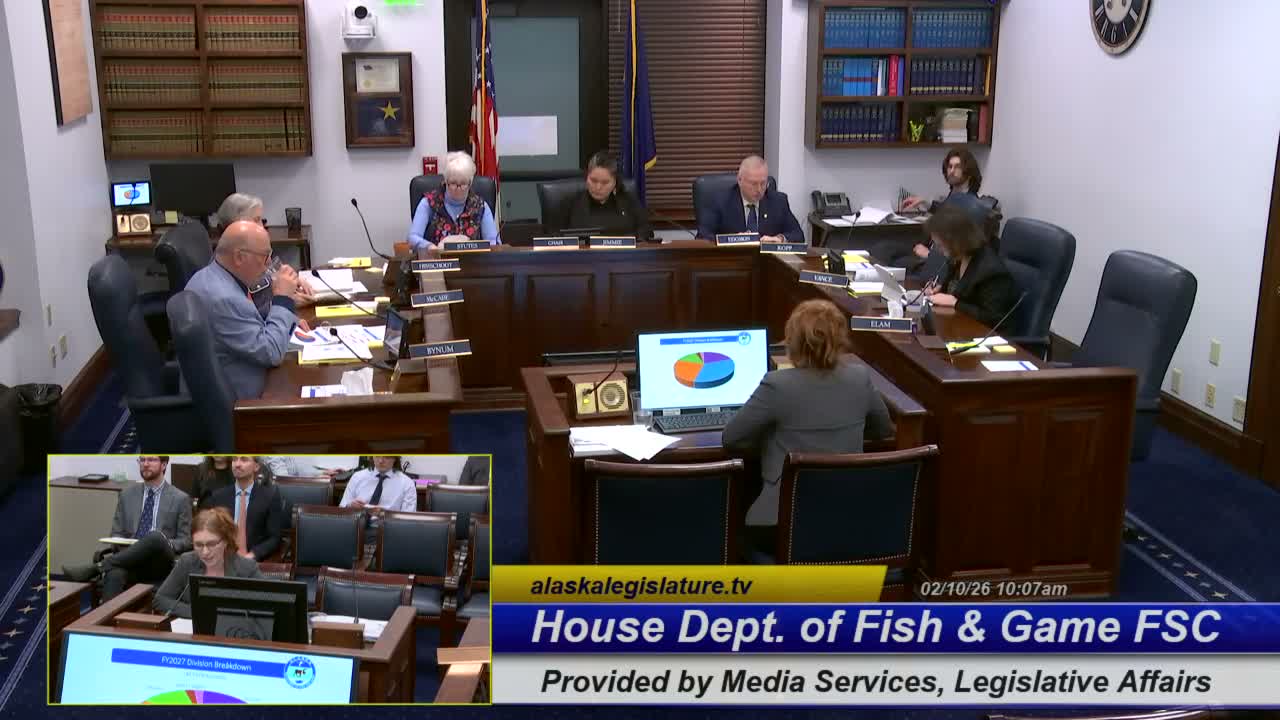
Summary
The Department of Fish and Game asked the subcommittee to approve a $274 million FY27 governor’s request, saying federal grants and Fish and Game Fund receipts make up the bulk of its revenue and that recent budget cuts forced the department to cancel or delay several field surveys and redirect maintenance dollars to an unexpected shipyard bill.
The Department of Fish and Game told the House Finance subcommittee on Feb. 10 that it is requesting $274,000,000 in the FY27 governor’s budget and that federal awards and license revenue will continue to account for the largest shares of its funding.
The request, presented by Administrative Services Director Bonnie Jensen and Commissioner Doug Vincent Lane, breaks the department into its major divisions — commercial fisheries (about 34% of the request), wildlife conservation (about 27%), sport fish (about 21%), statewide support services (about 13%), with subsistence and habitat making up smaller portions. Jensen said the department relies heavily on federal grants such as Pittman‑Robertson and Dingle Johnson awards and on the Fish and Game Fund, which together constitute the bulk of operating revenue.
Jensen told the committee that some planned projects were reduced or postponed after the legislature trimmed certain increments during the FY26 process. ‘‘We had to focus on core functions, critical assessments and management obligations,’’ Jensen said, describing canceled or scaled‑back work including the Sandy River Weir project, a Prince William Sound trawl survey, and reductions to the Lower Yukon test fishery and Togak hearing project.
The presentation noted specific agency needs: higher lease costs for the pathology lab in Juneau, additional archival space for the mark/tag/age lab (owned by the University of Alaska), and departmentwide requests for statutory designated receipt authority to cover recurring core services such as phone and lease payments. Jensen said the department asked to delete one IT help‑desk position that remained vacant after a prior reorganization, citing operational efficiencies.
Commissioner Doug Vincent Lane framed the budget in historical context, telling the committee that when he took office eight years ago the department’s budget was roughly $195 million and has since increased. He told policymakers the larger budget is not an end to every problem but provides greater capacity to address pressing fisheries and wildlife management questions.
The department also reported staff and organizational changes tied to statewide administrative moves: deconsolidation of payroll will add six payroll positions (four filled), and seven accounts payable/travel positions moved from Shared Services Alaska are filled, Jensen said.
The presentation included a reminder that multiyear authorities — for example, fishery disaster funds distributed through Pacific States Marine Fisheries Commission cooperative agreements — remain open amounts because federal awards and disaster declarations vary by year.
The meeting record shows continued urgency among lawmakers to protect field data collection and management capacity as the department balances federal, special fund and state resources. Chair Jimmy closed the hearing after roughly an hour of presentation and questioning; the subcommittee will schedule follow‑up meetings to continue oversight.