Trust details MTAR and authority grants, crisis response work and support for community programs
Loading...
Summary
The Alaska Mental Health Trust described roughly $11.4 million in MTAR increments proposed for FY‑27, authority grants to nonprofits and state partners, and continued emphasis on the scribe/988 call center and mobile crisis teams; Trust staff said authority grants and board discretion enable rapid responses to emergent needs.
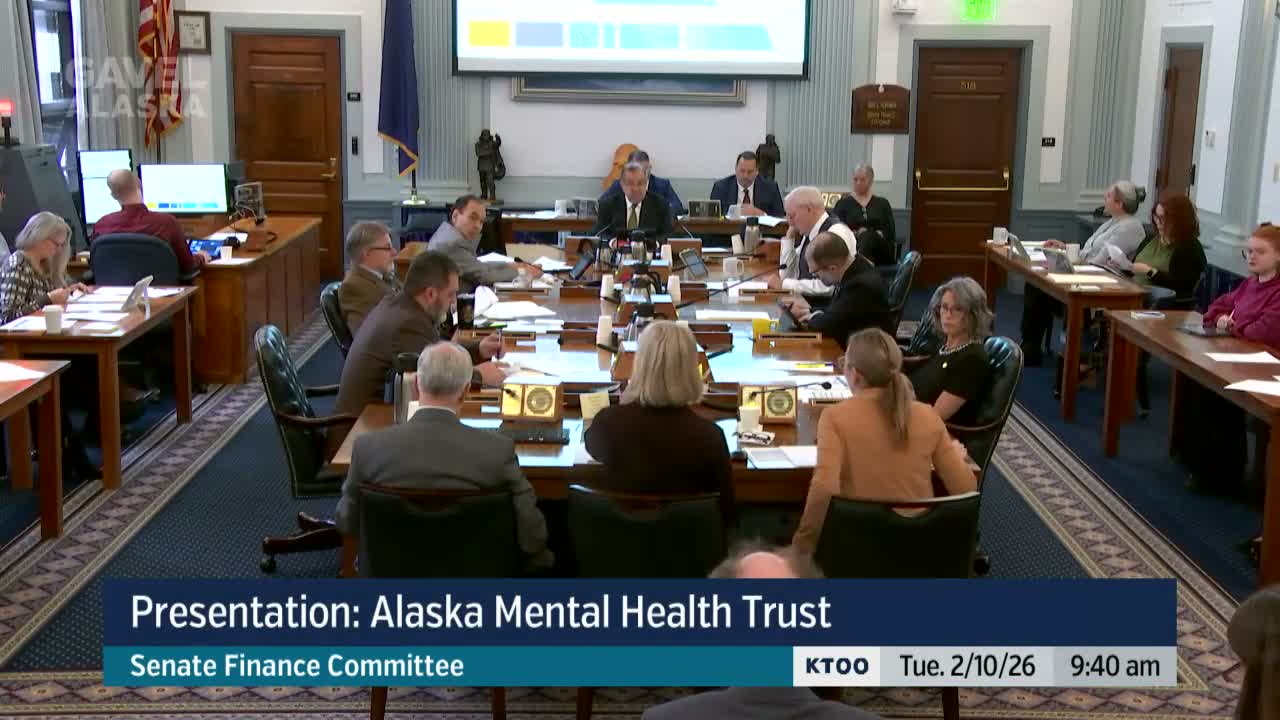
The Alaska Mental Health Trust Authority told the Senate Finance Committee on Feb. 10 that MTAR grants to state agencies and authority grants to community organizations remain central to its strategy and that crisis response remains a top priority.
"Of the 11,400,000.0, these are grants to our state of Alaska partners that receive trust funds through the state of Alaska budget process," said Katie Baldwin Johnson, chief operating officer, describing MTAR increments for FY‑27. She noted more than 60 MTAR increments transmitted to be included in the FY‑27 budget and that a handout lists all MTAR items.
Baldwin cited examples of MTAR and authority grant activity: support for peer support certification through the Department of Health Division of Behavioral Health; a Senior and Disability Services award for adult protective services that assisted 183 beneficiaries and trained more than 100 people last year; and multi‑year grants such as South Central Foundation's traumatic and acquired brain injury project (about $1.3 million annually) and a below‑market lease for Tanana Chiefs Conference to operate an adult behavioral health treatment facility.
Baldwin said the Trust approved $7 million in direct grants in the previous fiscal quarter and highlighted mini grants for individual beneficiaries, grant‑writing support to help partners secure federal and foundation funds, and that over three years Trust investments generated an estimated $45 million in new grant dollars for the state.
On crisis response, Baldwin and Wilson said the scribe call center (operating the 988 line) and mobile crisis teams are essential: "The scribe call center responds to calls for suicide prevention, individuals in stress 24 hours a day," Baldwin said, and mobile teams have performed more than 10,000 responses with a very high percentage resolved in community.
When a senator asked about two Western Alaska communities where roughly 1,600 people were displaced, Trust officials said they are coordinating with state and local partners (including South Central Foundation) and that authority grants or the state budget process are possible avenues for support; they said they would remain ready to collaborate on responses that are developed by local partners.