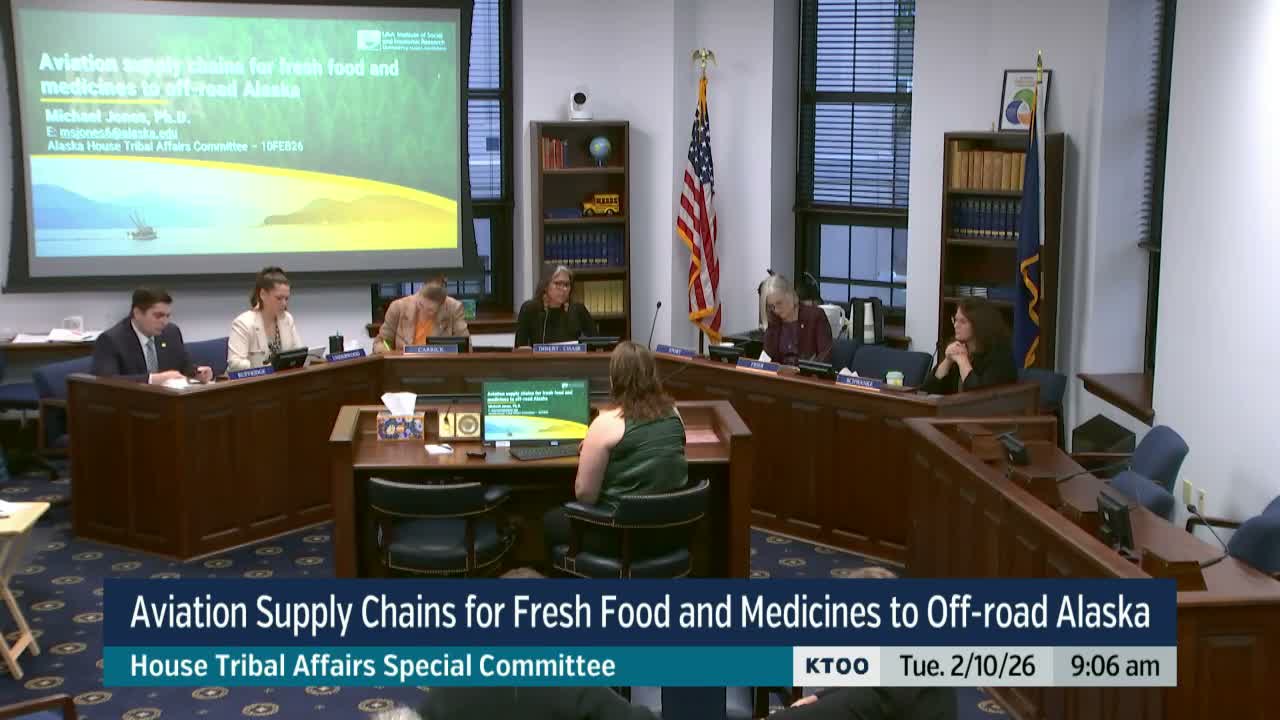
Research shows aviation outages and long routes drive high spoilage, medicine delays in rural Alaska
Loading...
Summary
UAA/ISER researcher Mike Jones told the House Tribal Affairs Committee that aviation dependence, AWOS outages and long multi‑flight routes cause high spoilage for perishables in downstream villages and substantial delays for medicines, and outlined ongoing analysis tying outages and weather to spoilage and transit times.
Dr. Mike Jones, research assistant professor of economics at the University of Alaska Anchorage’s Institute of Social and Economic Research, told the House Tribal Affairs Committee on Feb. 10 that Alaska’s aviation network is central to delivering food and medicines to off‑road communities—and that failures and route complexity produce large losses and health risks.
Jones said Alaska’s air cargo dependency is extreme: “Alaska has a state average at about 550 pounds per capita,” he said, far above other states. Using ADS‑B flight data and carrier statistics, he mapped hub‑and‑spoke flows with Anchorage as the primary regional hub and showed how mainline disruptions or outages at a hub can cascade to downstream hubs and remote villages.
He described recurring outages in automated weather observation systems (AWOS/ASOS) and other station failures that can last days to months in some locations, hindering pilots’ ability to fly under instrument flight rules. Jones said the Don Young Alaska Aviation Safety Initiative (DIASI) is investing in aviation infrastructure and automated weather sites that could improve reliability.
Jones presented spoilage data from Alaska Commercial Company stores showing stark differences by route and food type. He said hub markets such as Bethel often record low single‑digit spoilage rates for salad vegetables, while downstream villages such as Hooper Bay and Togiak commonly show spoilage averages in the 20–40% range for the same categories. “These kinds of spoilage levels are staggering,” Jones told the committee.
On pharmaceuticals, Jones described de‑identified shipment records from tribal health organizations (Southcentral Foundation and partners) that reveal route‑dependent transit times: one‑segment (on‑road) routes average about 1.5 days, one‑flight rural routes about 3 days, two‑flight routes about 5 days, and multi‑segment deliveries to remote Aleutian communities can average more than 10 days. He said for some communities roughly half of shipments take more than five days and that extreme‑delay months can include a high share that take more than 10 days.
Jones said the research will proceed to econometric analysis linking weather conditions, station outages and congestion to spoilage and delays; he is pursuing further data through FOIA requests and partnerships with tribal health corporations. He also noted operational differences in shipping: bypass mail (a subsidized USPS program) serves many remote communities but lacks statutory cold‑chain requirements and can be slower or harder to trace than contracted air freight.
Committee members asked about aircraft equipage (ADSB) and indoor agriculture economics; Jones said satellite ADS‑B visibility is higher than ground stations but equipage rates in Alaska are relatively low (he cited an FAA review finding ~27% equipage among N‑registered aircraft). He said energy costs and regional variation make the economics of local indoor production complex and that more comprehensive economic study would be needed.
Chair Divert thanked Jones and committee members for the discussion; Jones said the team will continue to refine the data and modeling and share results with partners.