
Alaska Senate panel hears testimony on bill to clarify RCA authority over LNG gas costs
Get AI-powered insights, summaries, and transcripts
Sign Up Free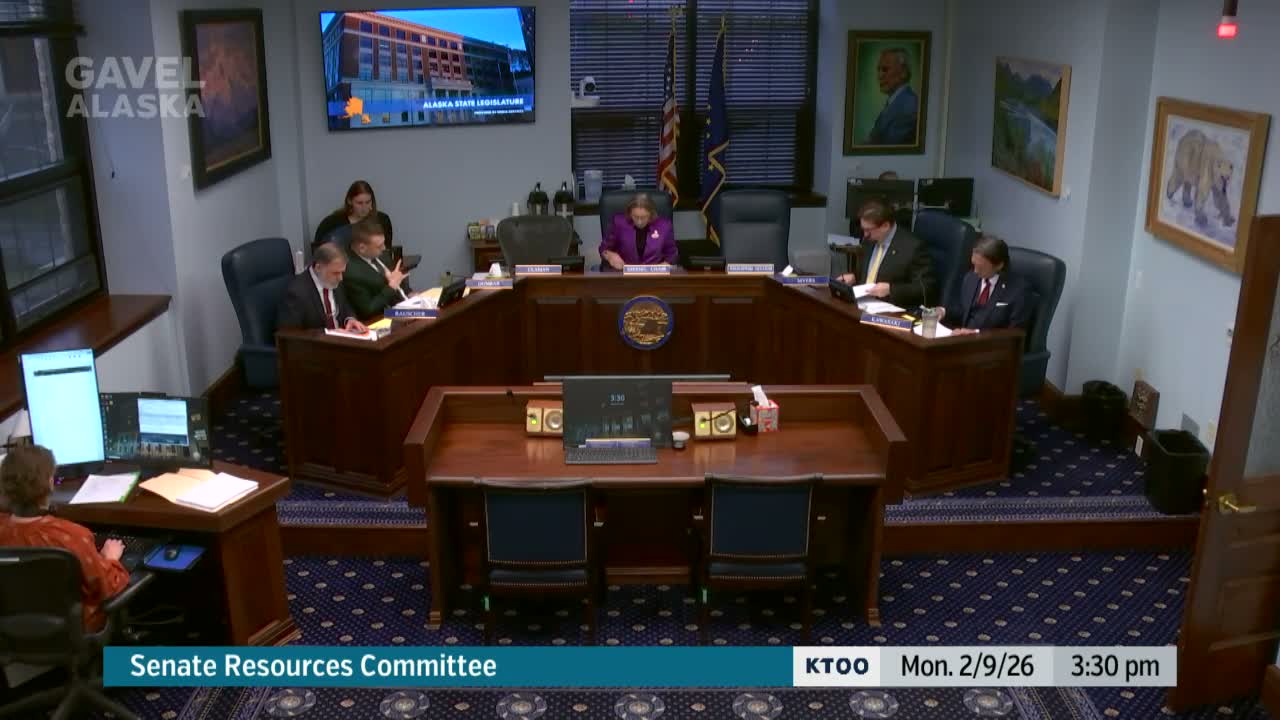
Summary
The Senate Resources Committee heard testimony on SB 180, which would repeal a sentence in House Bill 50 and clarify that the Regulatory Commission of Alaska can review gas-supply and terminal-use agreement costs tied to LNG import facilities; the committee set the bill aside for a future meeting.
The Alaska Senate Resources Committee on Feb. 9 heard testimony on Senate Bill 180, a one-sentence measure that would repeal a provision in House Bill 50 and clarify the Regulatory Commission of Alaska’s (RCA) authority to review costs tied to liquefied natural gas (LNG) import facilities.
Chair Giesel opened the meeting by saying the bill is “very simple” and designed to remove a confusing sentence added to HB 50 that has produced inconsistent interpretations about whether the RCA can review gas-supply and terminal-use agreement costs that utilities may seek to include in consumer rates. “This is simply saying, let’s repeal this so the confusion doesn’t exist,” the chair said.
Commissioner Steve DeVries of the RCA, who testified for the commission, summarized the agency’s April 22, 2025 order in docket U25004, order 5, which the packet shows addressed competing claims over jurisdiction in a prior matter involving an LNG import proposal. DeVries told the committee that while FERC has exclusive jurisdiction over the siting, construction and operation of an LNG import facility, the commission’s review of costs proposed for inclusion in utility rates (for example under a gas-supply agreement or a terminal-use agreement) remains within RCA purview in many instances. He told senators that “elimination of subsection (b) would just provide additional support for our claim” and reduce arguments a court could use to overturn an RCA determination.
Senators pressed DeVries on practical effects. Senator Myers asked whether the bill would shift the point at which RCA jurisdiction begins and whether removing the HB50 sentence would make it easier for construction or refurbishment costs to be passed to consumers. DeVries replied the bill does not grant the RCA authority over facility construction — FERC retains that authority — but would strengthen the commission’s legal position when reviewing whether contract terms or proposed costs are jurisdictional and reasonable for inclusion in rates. “Whether or not we allow those contracts or those costs to be included in rates is our jurisdiction to determine,” DeVries said.
The RCA’s testimony also noted statutory and jurisdictional nuances: the order discusses a state-commission mechanism (referred to in testimony as the Henshall/Hinshaw vehicle) by which a state commission can request oversight in some interstate contexts, but DeVries said that mechanism would not apply where the gas involves foreign commerce, which is the case for the import projects under discussion.
Committee members flagged other points in the record. Giesel pointed senators to the packet’s minutes from Jan. 15, 2025, where Commissioner Pickett read the HB50 language and warned that the clause may have been inserted in a committee substitute late in session with no clear author, creating the present uncertainty. Senator Dunbar referenced a briefing from J and L Properties that asserted legislative intent limiting RCA authority; the chair said she found no clear legislative record showing who inserted the sentence.
Witnesses listed in the packet included John Espindola (identified as RCA chairperson), Commissioner Steve DeVries, Julie Vogler (utility master analyst, RCA) and Claire Knudsen Lada (identified in the transcript first as DCCED staff and later corrected on the record to the RCA). The committee noted inconsistent spellings and references in the record to project names and parties (transcript and packet refer to a greenfield proposal spelled both “Glenfarn” and “Glenfern,” and the utility/developer names appear in varying forms in the packet); the committee did not resolve those inconsistencies at the hearing.
No formal vote was taken on SB 180. Chair Giesel said she would “set this bill aside for a future committee meeting,” and the committee adjourned. The chair said the committee will reconvene on Wednesday, Feb. 11 at 3:30 p.m., when Alaska Railroad President and CEO Bill O’Leary is scheduled to present on the railroad’s readiness for the pipeline project and possible bonding roles.
What’s next: SB 180 was laid aside for a future Resources Committee meeting; there was no roll-call vote recorded at the Feb. 9 hearing.