
DNR outlines FY27 plan: timber deals, mineral mapping and slow start for carbon offsets
Get AI-powered insights, summaries, and transcripts
Subscribe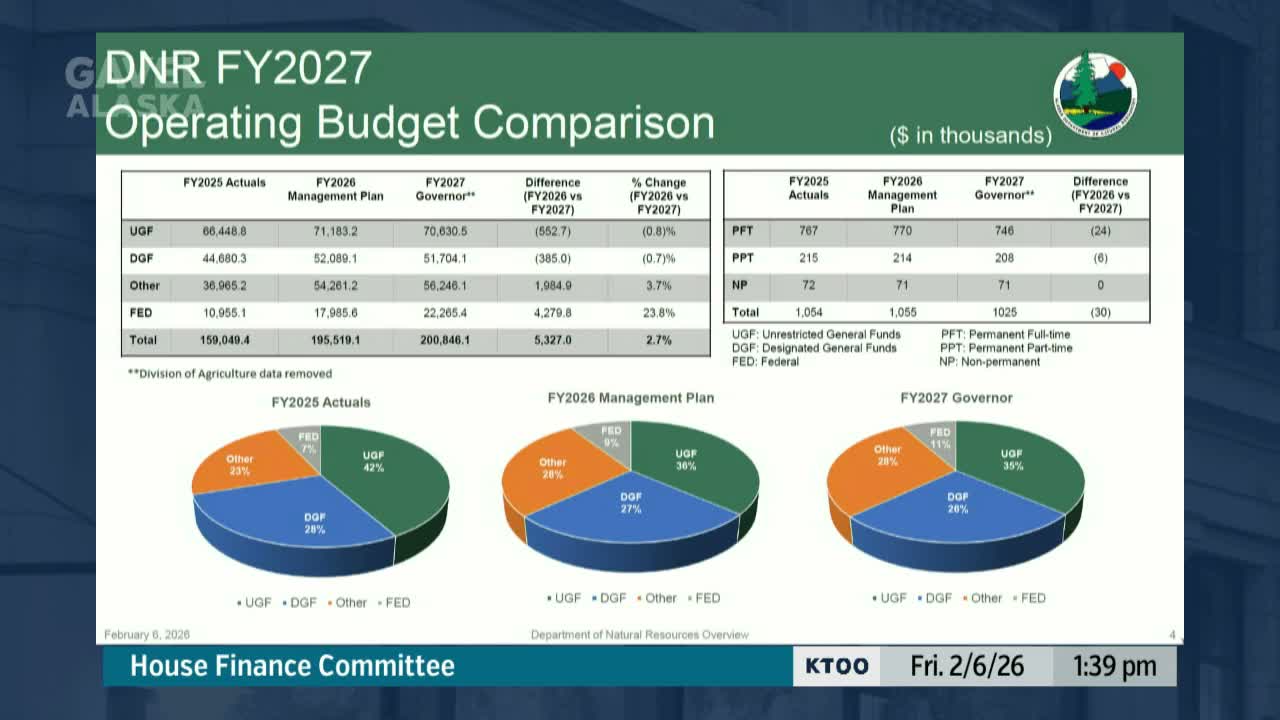
Summary
The Department of Natural Resources told the House Finance Committee its FY27 budget shifts program authority from capital to operating, boosts federal mapping grants and proposes timber and forest-management expansions, while carbon offset projects remain delayed amid market and registry changes.
The Department of Natural Resources told the House Finance Committee on Feb. 6 that its FY27 operating plan focuses on maximizing resource value, expanding timber management and completing a multi‑year shift of program authority from capital budgets into operating accounts.
Deputy Commissioner Brent Goodrum said the department expects its largest change in FY27 to be federal funds—an increase of about $4.3 million, roughly 24 percent—and a modest overall operating increase of 2.7 percent from the FY26 plan. He described three drivers of budget change: moving longstanding programs (and federal matching authority) from capital to operating, increased interagency receipt authority for hazard and disaster response, and implementing an information‑technology classification study that affects 29 DNR positions.
Why it matters: DNR manages state lands, water, minerals, oil and gas and other resources that produce revenue to the state. Goodrum told the committee that "on a 10‑year revenue average, for every general fund dollar appropriated to DNR, DNR generates $22 in revenue," framing the department as a net revenue engine in the FY27 request.
The presentation included several line‑item proposals that affect regional economies. DNR is pursuing a Good Neighbor Authority partnership with the U.S. Forest Service, proposing a permanent forester position in Ketchikan and a 30‑year stewardship agreement to increase timber activity in Southeast and Southcentral Alaska. Goodrum also described a shift of geological and geophysical mapping (the Earth MRI program) into the operating budget, funded by a U.S. Geological Survey grant of about $5.8 million with no state match requested.
Law and land transfers: The department said it will seek to continue statehood land entitlement transfers and to implement authority granted by recent laws. Goodrum listed related legislative items, including a bill to expand the Tanana Valley State Forest (House Bill 218; companion Senate Bill 188) and measures to enable timber‑management leases (House Bill 72 and Senate Bill 75).
Agriculture reorganization: Several representatives pressed DNR officials on the governor’s plan to stand up a separate Department of Agriculture under Executive Order 137 and move positions and funding from DNR. Goodrum said the FY27 budget moves the structure and associated funding into the new department (about $5.8 million and 17 permanent positions for some items), and that preparatory work so far has been absorbed by agencies. He added that if the new department is not enacted, many of the positions would be repurposed within DNR divisions such as forestry and fire protection.
Carbon programs and CCUS: Committee members asked about forest‑based carbon offsets and underground carbon storage. DNR said its offset regulations were established in 2024 and DNR has engaged contractors and registries, but registry standard changes and market shifts have delayed projects; the department has not initiated reforestation projects yet. On carbon capture, utilization and storage (CCUS), DNR said the Alaska Oil and Gas Conservation Commission is finalizing Class VI regulations needed for injection well permitting, DNR has authority to issue leases for underground pore space, and no leases or revenue have been recorded yet. The department compiled geologic and land‑ownership data to help prospective projects on the North Slope and in Cook Inlet.
What’s next: DNR officials offered to provide follow‑up details requested by the committee, including definitive answers on how any carbon revenues would be designated and further documentation on transfers and position counts.
(Reporting based solely on committee testimony; no formal votes were taken on DNR items.)